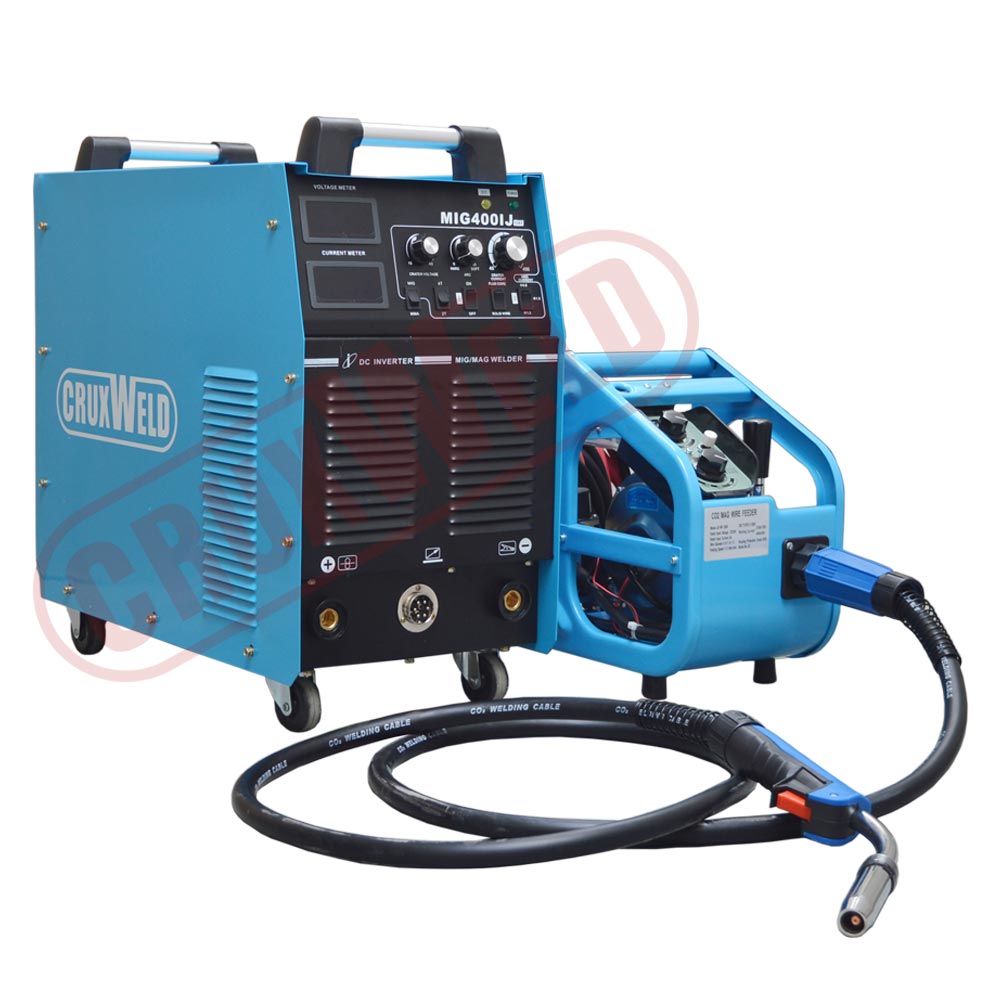
Two everyday jobs for the CRUXWELD CWMIG400iJ: light frames in 5–8 mm steel and heavier base plates in 10–16 mm. See the joints, the settings to start from, and what each metre of weld costs.
Material trolleys, workbench frames, machine stands and racks. Mostly square or rectangular tube and angle, joined with short fillet welds at every corner. Maintain the specified weld size and adequate fusion; then optimise travel speed and spatter for productivity.
| Wire | 1.0 mm |
| Current | about 180–240 A |
| Voltage | about 20–25 V |
| Gas flow | about 15 L/min |
A starting point only. Set the final values on a scrap piece of the same tube; our technical team can set them with your operator on a video call.
Illustration, not a customer job. Orange dots mark the fillet welds.
Job as entered in the calculator: 4 mm fillet on 5 mm tube, one side, 500 mm per joint × 40 joints (20 m of weld). Assumptions: MIG/MAG solid wire ER70S-6 with CO2, 220 A / 24 V, deposition 2.97 kg/h, 40% arc-on time, no setup or handling time; illustrative Indian rates (Oct 2026): wire ₹115/kg, gas ₹60/m³, labour ₹175/h, power ₹8/kWh. Result: about ₹438 for the job, 1.2 hours. Change any value to your own.
Column base plates, machine mounting plates, lifting brackets and stiffeners. Bigger fillets, often welded all round and in more than one pass. Here you need current to spare and a wire that can lay down metal quickly.
Illustration, not a customer job. Orange lines mark the fillet welds.
Job as entered in the calculator: 8 mm fillet on 12 mm plate, one side, 1200 mm per joint × 10 joints (12 m of weld). Assumptions: MIG/MAG solid wire ER70S-6 with CO2, 280 A / 28 V, deposition 3.78 kg/h, 40% arc-on time, no setup or handling time; illustrative Indian rates (Oct 2026): wire ₹115/kg, gas ₹60/m³, labour ₹175/h, power ₹8/kWh. Result: about ₹938 for the job, 2.3 hours. A bigger fillet needs about four times the metal of a 4 mm fillet, so cost per metre rises fast.
| Wire | 1.2 mm |
| Current | about 250–320 A |
| Voltage | about 26–32 V |
| Gas flow | about 15–18 L/min |
A starting point only. Large fillets are laid in several passes; check fit-up and leg size on a test piece first.
The same four steps apply to both jobs. Most rework comes from steps 1 and 2, not from the welding itself.
One machine covers light tube and thick plate: the current range runs from 40 A for thin work up to 400 A for large fillets, and it takes 0.8–1.4 mm wire. It runs on a standard 415 V three-phase workshop supply.
| Model | CWMIG400iJ (inverter) |
| Input supply | AC 415 V ±15%, 3 phase, 50/60 Hz |
| Current setting range | 40–400 A |
| Voltage setting range | 16–34 V |
| Welding current @60% duty cycle | 400 A |
| Welding current @100% duty cycle | 310 A |
| Wire feed speed | 1.5–20 m/min, stepless |
| Suitable wire diameter | 0.8–1.4 mm |
Yes. The 40–400 A range and 0.8–1.4 mm wire cover thin tube and thick plate. Change the wire size and settings between jobs rather than changing machines.
CO2 costs less per cylinder. An argon/CO2 mix gives a smoother arc and less spatter, so less grinding after welding. Use the cost calculator with both gas prices to compare for your job.
Open the welding cost calculator, choose MIG, enter the joint, plate thickness, weld length and your own rates. It shows cost per metre, per joint and per job, and metres of weld per hour.
Yes. Our technical team helps on WhatsApp and video call with wire, gas and settings for your job.
Send a photo or drawing of what you make, the plate thickness and how many pieces a day. Our technical team replies with a machine suggestion and quotation.
45+ years of welding expertise · GeM Registered OEM Manufacturer · Supported Worldwide

