Troubleshooting guide › Specialised welding › Dent puller spot welder
A dent puller welds a pulling point (round pad, triangle pad, wiggle wire or stud) to the outside of a steel panel so the dent can be pulled without stripping the trim. The weld has to be strong enough to pull and weak enough to twist off cleanly, on 0.6-1.2 mm sheet, without a hole. Nearly every complaint is one of three: the pad comes off, the panel burns, or the metal ends up stretched. All three are settings and technique.
Reviewed by the Cruxweld technical team, October 2026. Settings are starting points to confirm on a test piece; acceptance is decided by the code or drawing the job is built to. Checks marked “call” are for our technical team.
| Dent | Mode / accessory | Note |
|---|---|---|
| Shallow round dent, soft edges | Round pulling pad, slide hammer or lever puller | Several light pulls from the edge inwards beat one hard pull in the centre |
| Sharp, small, deep dent | OT / triangle pad | Force concentrated on one point |
| Long crease or large shallow area | Wiggle (corrugated) wire with a bar puller | Pulls a line, not a point; move along the crease |
| Metal already stretched (oil-can, bulge) | Carbon-rod heating (shrinking) then hot pressing | Heat a spot, let it dull, flatten; small spots, not a large area |
| High spots after pulling | Hot pressing / flattening | Light touch; repeat rather than overheat |
| Pull point on a thick edge | Stud (meson) welding | Then pull on the stud with the puller |
| Joining an overlapping patch from one side | Single-sided spot welding | Panels clean and tight |
Power too low for the panel; paint, primer, e-coat or rust under the pad (the weld needs bare metal); earth clamp far away or on paint; pad not pressed flat; pulling at an angle instead of straight out.
Power too high for the panel thickness; weld time held too long; panel thinner than 0.6 mm (rust-thinned or previously filled); pad pressed on an edge.
Pulled too hard or too far in one place; pad welded in the centre of the dent instead of working from the edge; heat from repeated welds in one spot.
Power too high: the weld is too deep and takes panel metal with it.
Rod held too long or pressed too hard; wrong mode selected.
Galvanised or high-strength steel panels need more power and a cleaner surface; aluminium panel (will not weld at all).
Duty cycle exceeded in continuous use; vents blocked.
Supply and fuse; earth clamp; gun cable plug; mode not selected; panel painted at the contact point.
No. Aluminium does not resistance-weld with this process; the pad will not stick and the panel will burn. Aluminium dent pulling uses a capacitor-discharge stud system made for aluminium, which is a different machine.
It is designed for 0.6-1.2 mm sheet, which covers car body outer panels. Thicker brackets and chassis parts need a stud welder, not a dent puller.
Open your model for its specifications; the spares page lists the consumables for it.
If the machine runs but the weld or cut is wrong, the cause is usually settings, consumables or the material. Start here:
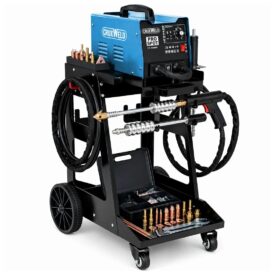
The DentPro 90 is a steel-panel machine: its modes and outputs (AC 1-7 V for pad and stud welding, 3-5 V for carbon-rod heating) are set for 0.6-1.2 mm steel. Aluminium panels need a different process (capacitor-discharge stud pulling on aluminium) and are not covered by this machine. Overheat protection and air cooling allow continuous shop use.
Send a photo of the weld or cut, your machine model, consumable and plate thickness. Our technical team replies on WhatsApp with the likely causes and the next checks to make.
45+ years of welding expertise · GeM Registered OEM Manufacturer · Supported Worldwide