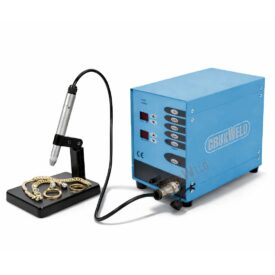
Troubleshooting guide › Specialised welding › Jewellery pulse-arc welding
A pulse-arc jewellery weld is a single TIG-like pulse of a few milliseconds under argon, aimed through a microscope. It is clean and tiny when the gas, the electrode tip and the power are right, and black or pitted when any one of them is wrong. This page is for permanent jewellery chains, jump rings, prongs and small repairs in gold, silver, platinum and steel.
Reviewed by the Cruxweld technical team, October 2026. Settings are starting points to confirm on a test piece; acceptance is decided by the code or drawing the job is built to. Checks marked “call” are for our technical team.
No or low argon (cylinder, regulator below 0.1 MPa, hose), gas lamp flashing; deflate time too short so the arc fires before the gas covers the spot; draught from a fan or window.
Power too high for the piece; electrode blunt; metal dirty or carrying polish compound.
Power too low; ends not touching before the pulse; gap at the joint; metal with a high-conductivity alloy needing more energy.
Pressing the piece hard onto the tip; blunt or contaminated tip; deflate time too long.
Ready lamp not yet on (Wait means charging); circuit clip not on the piece or not making contact through the chain; electrode exposed length wrong (10-15 mm).
Power and time for the metal and wire size; a preset pattern not suited to the job.
Cover lens coated with weld spatter; filter aged (about two years); optics dirty.
After five minutes with no operation it returns to the Ortho pattern. Re-select your pattern before the next weld.
That is what permanent jewellery welding is: the pulse is milliseconds and the piece is clamped a few millimetres from the skin. Use the leather guard, keep the chain taut, and practise on scrap chain first.
Open your model for its specifications; the spares page lists the consumables for it.
If the machine runs but the weld or cut is wrong, the cause is usually settings, consumables or the material. Start here:
The machine is only as good as its argon supply (at least 0.1 MPa, up to 5 L/min) and its electrode tip. The gas lamp under the Select button flashes when the pressure cannot meet the demand of the set power; a flashing lamp and a black weld are the same fault.
Send a photo of the weld or cut, your machine model, consumable and plate thickness. Our technical team replies on WhatsApp with the likely causes and the next checks to make.
45+ years of welding expertise · GeM Registered OEM Manufacturer · Supported Worldwide