Troubleshooting guide › Fix it yourself, by machine › ARC transformers and rectifiers
Transformer machines and rectifiers are the workhorses that run for 20 years. They have no electronics to fail, so when one stops it is almost always a connection, a fuse, a phase or the fan. This page is for the CWA-ARC AC series (moving-core current control) and the CWR diode rectifiers (transductor control).
Reviewed by the Cruxweld technical team, October 2026. Settings are starting points to confirm on a test piece; acceptance is decided by the code or drawing the job is built to. Checks marked “call” are for our technical team.
| What you see | Check yourself | If it persists |
|---|---|---|
| Machine does not power up, lamps off | Supply on both/all lines; mains fuse; isolator contacts; ON/OFF switch; control fuse (rectifier) | Control transformer: call |
| One phase lamp off (rectifier) | A phase is missing: stop welding | Supply or mains fuse; do not weld on two phases |
| Machine on, no output, fan runs | Cables and lugs; work clamp; output terminals tight; machine not overheated; REMOTE selected with no remote | Call |
| Fan does not run, output normal | Fan fuse (rectifier); fan turns freely by hand (isolated); fan leads | Fan motor: call. Do not weld long without the fan |
| Welding current erratic | Loose mains or welding connections; damp electrodes; supply fluctuating; worn regulator contact | Regulator: call |
| Weak, sluggish arc | Current too low or LOW range selected; low supply voltage; cables too long or thin; loose connection | Call with the supply reading |
| Current cannot be adjusted / handle stiff (transformer) | Lead screw and shunt dry or dirty; anti-noise screws over-tightened | Grease the screw (high-temperature grease); shunt mechanism: call |
| Only minimum current, will not increase (rectifier) | Control fuse; regulator knob; range links | Control transformer or rectifier: call |
| Control fuse blows repeatedly (rectifier) | Nothing outside | Control transformer, fan or regulator: call |
| Excessive spatter, unstable arc | Current too high; arc too long; damp electrodes; wrong polarity (rectifier) | Failed diode on a rectifier: call |
| Machine overheats | Duty cycle; louvres blocked; dust inside; fan not running | Let it cool with the fan running; if it overheats at low current: call |
| Loud humming or rattling (transformer) | Normal hum is fine; a rattle is the shunt or a loose panel | A qualified person tightens the anti-noise screws a quarter turn at a time; tighten panels |
| Mains fuse blows | Fuse rating as recommended (63 A for a 450 A transformer); input cable for damage | Short circuit in the primary or diodes: call |
The scale on a transformer machine is approximate; the actual current depends on supply voltage, cable length and arc length. Set by the bead and the electrode range, not by the pointer.
A rectifier is simpler, tolerant of dust and rough supply, and has no boards to fail; an inverter is lighter, more efficient and has hot start and arc force. For a fixed bay with heavy electrodes, many shops still prefer the rectifier.
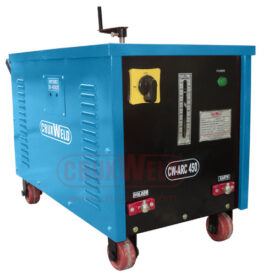 ARC 450A transformerSpecifications →
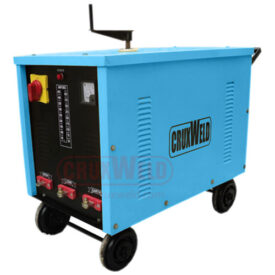 ARC 350 ASpecifications →
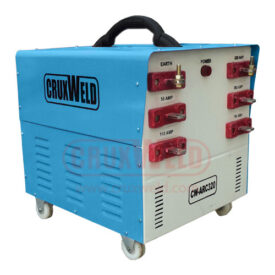 ARC 320 ASpecifications →
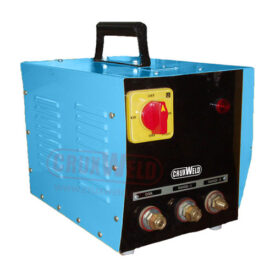 ARC 220 ASpecifications →
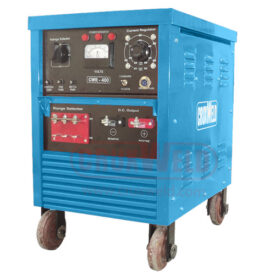 Welding Rectifier 400Specifications →
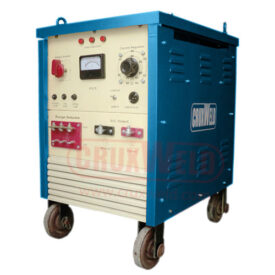 Welding Rectifier 600Specifications →
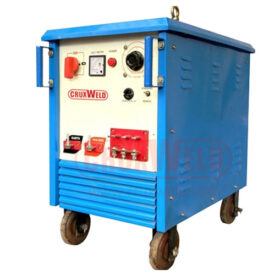 Thyristor rectifier 400Specifications →
Open your model for its specifications; the spares page lists the consumables for it.
If the machine runs but the weld or cut is wrong, the cause is usually settings, consumables or the material. Start here:
A transformer machine that overheats is being run over its duty cycle: 60 % at the rated current, continuous at about 75 % of it. Overheating damages the transformer insulation and that is a workshop repair, so respect the rest periods or move up a size.
Send a photo of the weld or cut, your machine model, consumable and plate thickness. Our technical team replies on WhatsApp with the likely causes and the next checks to make.
45+ years of welding expertise · GeM Registered OEM Manufacturer · Supported Worldwide

