Troubleshooting guide › Fix it yourself, by machine › Welding generators
A welding generator is an engine, an alternator and a welding control in one box, and most faults are engine faults that any diesel mechanic understands: fuel, air, oil, battery. The welding side has only cables and a current control. This page separates the two so you call the right person.
Reviewed by the Cruxweld technical team, October 2026. Settings are starting points to confirm on a test piece; acceptance is decided by the code or drawing the job is built to. Checks marked “call” are for our technical team.
| What you see | Check yourself | If it persists |
|---|---|---|
| Engine does not crank | Battery flat, terminals loose or corroded; emergency stop pulled; main switch | Starter motor: engine mechanic |
| Cranks but will not start | Fuel in the tank, fuel valve, air in the fuel line (bleed), fuel filter, water in the fuel, glow / preheat on cold mornings | Injector or pump: engine mechanic |
| Starts then stops | Fuel running out; low oil pressure cut-out (check the level); high temperature cut-out; overload | Sensors or governor: engine mechanic |
| Overheats | Coolant level (liquid-cooled sets), radiator fins, fan belt tension, air inlets and outlets, ambient and load | Thermostat or water pump: engine mechanic |
| Black smoke | Overload (welding plus auxiliary), dirty air filter | Injectors: engine mechanic |
| White or blue smoke | Cold start (normal for a minute); oil level too high; worn engine | Engine mechanic |
| Engine speed hunts, arc pulses | Fuel filter partly blocked; air in fuel; governor linkage | Governor: engine mechanic |
| Charging lamp on while running | Fan belt loose or broken | Alternator or regulator: call |
| What you see | Check yourself | If it persists |
|---|---|---|
| No welding output, engine runs | Output cables and studs tight; earth clamp; overload protection tripped (let it cool, reset); engine at full speed (not idle mode) | Welding alternator or control: call |
| Weak or unstable arc | Current set too low; cables too long or thin; poor work connection; engine not at rated rpm; air filter | Call with the engine speed reading if you can measure it |
| Arc fine alone, bad when a tool is plugged in | Combined load above the rating; motors need 2-3 times their running power to start | Use auxiliary power between welds, or size the set for both |
| Excessive spatter | Current too high; arc too long; polarity | See the ARC process page |
| No auxiliary power | Auxiliary breaker (MCCB) off or tripped; overload; socket and plug; engine at rated speed | Auxiliary winding: call |
| Auxiliary voltage too high or low | Engine speed; overload | Governor or AVR: call |
| Output studs or cables hot | Loose lug, burnt clamp, undersized cable | Replace; a hot stud is a fire risk |
| Interval | Work |
|---|---|
| Daily / every 8 h | Oil, coolant and fuel levels; leaks; dust off air inlets and radiator; welding cables and connections |
| Every 50 h | Clean or check the air filter (more often in dust); drain the fuel filter / water separator; fan belt tension; battery electrolyte and terminals |
| First 50 h, then as the engine maker specifies | Engine oil and oil filter change |
| Every 250 h | Fuel filter; air filter element if needed; hoses and clamps; tightness of alternator and control panel connections |
| Every 500 h / yearly | Coolant; valve clearance and injectors (engine mechanic); blow dust out of the alternator with dry low-pressure air |
Only if the combined load is inside the rating. On a 230 A / 5 kVA set, a 1 kW grinder while welding at 150 A is usually fine; a compressor is not. The arc tells you: if it weakens when the tool starts, the set is overloaded.
The first at 50 hours, then as the engine maker specifies (commonly every 100-250 hours). Count hours on the meter, not weeks.
Consumption rises with load: a 230 A diesel set burns about one litre an hour at moderate welding load and more at full output with auxiliary tools running. For welding cables, 50 mm2 up to about 30 m total run at 230 A and 70 mm2 beyond or for 400 A; a long thin cable shows as a weak arc that the current knob cannot fix.
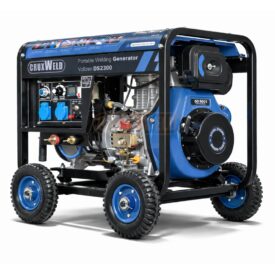 Voltzen DS2300Specifications →
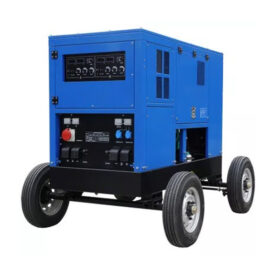 Diesel welding generator (single cylinder)Specifications →
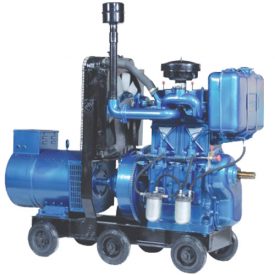 Diesel welding generator (double cylinder)Specifications →
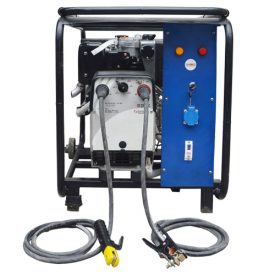 Petrol welding generatorSpecifications →
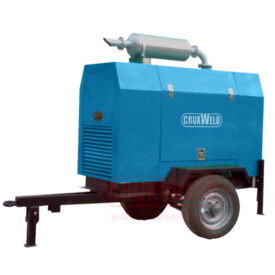 Welding generators rangeSpecifications →
Open your model for its specifications; the spares page lists the consumables for it.
If the machine runs but the weld or cut is wrong, the cause is usually settings, consumables or the material. Start here:
The welding output follows engine speed. A generator that welds badly when the grinder is plugged in, or after 500 hours without an air filter change, is not a welding fault. Keep the engine serviced on hours, not on calendar months.
Send a photo of the weld or cut, your machine model, consumable and plate thickness. Our technical team replies on WhatsApp with the likely causes and the next checks to make.
45+ years of welding expertise · GeM Registered OEM Manufacturer · Supported Worldwide

