Troubleshooting guide › Fix it yourself, by machine › ARC inverter machines
An inverter stick welder has very little the operator can break and very little he can fix inside. What he can fix is everything outside: the supply, the two cables, the holder, the clamp and the electrode. That is where nearly every fault is. This page covers the single-operator iS and iJ inverters, the ARC630-2T dual-operator machine with gouging, and the waterproof site machines.
Reviewed by the Cruxweld technical team, October 2026. Settings are starting points to confirm on a test piece; acceptance is decided by the code or drawing the job is built to. Checks marked “call” are for our technical team.
| Indicator | Meaning | What to do |
|---|---|---|
| POWER lamp off, no preset current shown | Input fuse, phase loss, control board | Check the supply and the fuse; if present, call |
| POWER on, no preset current shown | Control board or ammeter | Call |
| OVERHEAT / protection lamp on, no action | Fan stopped, overload (duty cycle), control board | When the protection lamp is on, leave the machine switched on so the fan keeps running. It resets itself when it has cooled. Switching it off makes the wait longer. Check the fan runs. Run unloaded 10 minutes. If it trips under light load with the fan running: call |
| Machine air switch (rear breaker) trips at power-on | Input rectifier, capacitor or IGBT fault | Do not reset repeatedly: call |
| Breaker trips after long high-current use | Overload and heat | Switch off the distribution cabinet, wait five minutes, close the machine switch first and then the cabinet switch |
| FAULT lamp (ARC630-2T) | Power source fault detected | Switch off, wait, retry once; then call |
| What you see | Check yourself | If it persists |
|---|---|---|
| No no-load voltage, abnormal noise inside | Switch off at once | Output diode fault: call |
| No-load voltage normal, arc breaks during welding | Three-phase supply voltage too low or a phase missing; cable too thin or too long; earth poor | If the supply is good: call |
| Welding current suddenly stops mid-weld | Welding cable contact at the work and at the machine; holder cable; control fuse (user-replaceable on some models) | Control fuse blows again: call |
| Arc weak, cannot reach rated current | Supply voltage under load; cable size; long cable run; low-range selected on dual-range models | Call with the supply reading |
| Electrode sticks, hard to start | Current too low, earth, damp electrode, hot start / arc force settings on the panel | See the ARC process page |
| Excessive sparks (ARC630-2T) | Wrong mode selected: welding vs gouging switch | Select the mode for the job |
| One operator has current, the other does not (ARC630-2T) | That side’s output lugs and cable, its own current setting, its earth | One channel faulty: call |
| Gouging weak (ARC630-2T) | Gouging mode selected, gouging current regulator up, compressed air 5-7 bar at the torch, carbon rod size for the current | Call |
| Lamp off, fan off, no arc | Mains voltage, input cable (flex it), isolator | If the input is good: call |
| Lamp off, fan running, no arc | Nothing you can fix outside | Call |
| Lamp on, fan running, no arc | Overheat protection: wait with the machine on | If still no arc when cool: call |
For a 400 A inverter on 415 V, a 4-core copper cable of at least 10 mm2 up to 30 m; larger beyond. Welding cables: 50 mm2 up to 300 A, 70 mm2 above, and bigger for runs over 30 m.
Yes, from a generator of at least 1.5 times the machine input kVA with stable voltage. Voltage spikes from a small generator can trip the protection and, in the worst case, damage the input stage.
Each channel has its own current setting and display; the total the machine can supply at its duty cycle is shared, so two operators at high current each must stay within the rating plate figures for simultaneous use. Gouging draws the highest current: run it on one channel while the other channel welds at moderate current, with compressed air at 5-7 bar at the gouging torch, and watch the overheating lamp.
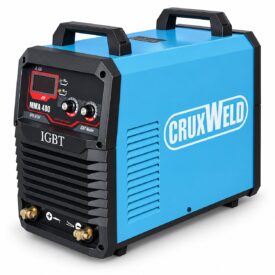 ARC400iS (ARC 400)Specifications →
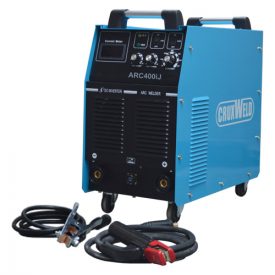 ARC400iJSpecifications →
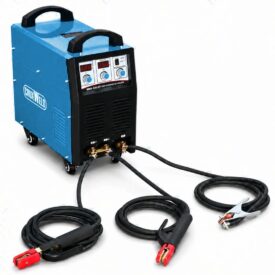 ARC630-2T dual operatorSpecifications →
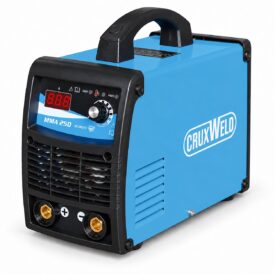 ARC 250Specifications →
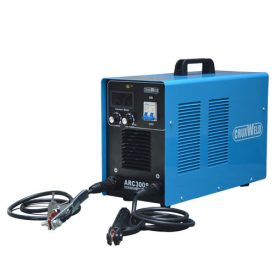 ARC 300Specifications →
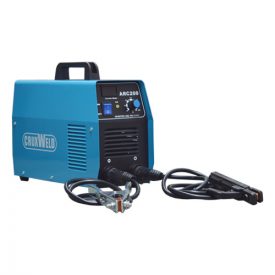 ARC 200Specifications →
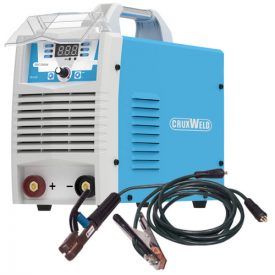 Waterproof ARCSpecifications →
Open your model for its specifications; the spares page lists the consumables for it.
If the machine runs but the weld or cut is wrong, the cause is usually settings, consumables or the material. Start here:
On a 415 V inverter a missing phase produces a weak arc that breaks under load, and the operator turns the current up to compensate; that overheats the machine. Check the phases before the current knob.
Send a photo of the weld or cut, your machine model, consumable and plate thickness. Our technical team replies on WhatsApp with the likely causes and the next checks to make.
45+ years of welding expertise · GeM Registered OEM Manufacturer · Supported Worldwide

