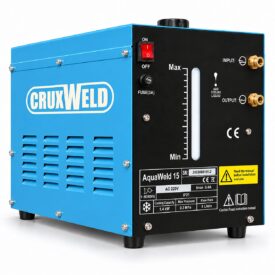
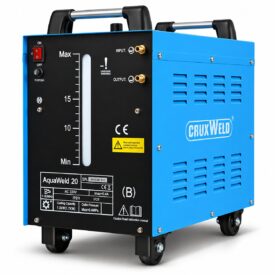
Troubleshooting guide › Fix it yourself, by machine › Welding torch water coolers
A torch cooler is a tank, a pump and a radiator. It has no flow switch and no low-level cut-out on these models, so the operator is the protection: check the level and watch the return before striking an arc. A water-cooled torch run dry is destroyed in seconds, which is why this short page exists.
Reviewed by the Cruxweld technical team, October 2026. Settings are starting points to confirm on a test piece; acceptance is decided by the code or drawing the job is built to. Checks marked “call” are for our technical team.
| What you see | Check yourself | If it persists |
|---|---|---|
| Nothing at switch-on | Supply, fuse or breaker, cable and plug | Switch: call |
| Motor hums, does not turn | Pump seized after standing idle: free it (below); low voltage | Starting capacitor: call |
| Runs, then stops | Thermal cut-out: blocked air path, high ambient, pump labouring on a kinked hose | Call if it stops with a clear air path |
| Breaker trips at each switch-on | Nothing outside | Short or water in the motor: call before restarting |
| Runs, air from the radiator, little or no flow | Pump lost prime after idling: free and bleed it | Call |
| Flow falls during the shift | Level dropped; hose kinked; torch passages furring up (flush or replace the torch) | |
| Pump noisy or surging | Air drawn in: level low or a suction-side joint leaking | |
| Good flow at the unit, torch still overheats | Hoses too long; torch passages blocked; welding current above the torch rating | |
| Coolant leaks from the pump shaft | Worn water seal | Fit a new seal before the leak reaches the motor: call |
Freeing a pump that has stood idle: unplug; tank at MAX; disconnect one hose at the INLET or OUTLET; apply clean, dry compressed air at low pressure to that connector for about 20 seconds; reconnect, switch on and check fluid returns to the tank; repeat once. Low pressure only; high pressure bursts hoses and torch passages. To prevent seizure, run the motor for a minute every fortnight when the unit is not in use.
| Lowest expected temperature | Ethylene-glycol antifreeze by volume |
|---|---|
| Down to 0 degrees C | None needed |
| Down to -10 degrees C | About 20 % |
| Down to -20 degrees C | About 33 % (cooling capacity begins to fall) |
| Down to -30 degrees C | About 45 % (maximum) |
Never propylene-glycol, engine coolant with additives, oil or used water. Mix before adding; never above 50 %. Check the mix at the start of each winter; let a unit stored below freezing reach room temperature before filling and starting.
Source: the coolant, antifreeze, hose and daily-check guidance on this page follows the Cruxweld AquaWeld 15 / 20 documentation. The only approved fluid is distilled or de-mineralised water (soft, clean tap water accepted), with ethylene-glycol antifreeze in the proportions above when needed. Where the page says “low pressure” for clearing an airlock, no figure is given on purpose: if you are not sure what pressure your air line delivers, do not blow the circuit; send us a WhatsApp and our technical team will walk you through it.
Soft, clean tap water is acceptable; hard water scales up the torch passages within months. Distilled or de-mineralised water is the safe choice, with ethylene-glycol antifreeze where it gets cold.
The torch still cools, but any flow indication reads wrongly. Blue to the machine water IN, red to the machine water OUT.
Open your model for its specifications; the spares page lists the consumables for it.
If the machine runs but the weld or cut is wrong, the cause is usually settings, consumables or the material. Start here:
Switch the cooler on before the welding machine and confirm the pump runs, the fan turns and fluid returns to the tank before the first arc. Hoses no longer than 10 m, 8 mm bore, blue OUT to the machine water IN and red IN to the machine water OUT.
Send a photo of the weld or cut, your machine model, consumable and plate thickness. Our technical team replies on WhatsApp with the likely causes and the next checks to make.
45+ years of welding expertise · GeM Registered OEM Manufacturer · Supported Worldwide