Troubleshooting guide › Fix it yourself, by machine › TIG welding machines (DC)
A TIG machine has one more thing to go wrong than a stick machine: the HF arc starter and the gas valve. Almost every “no arc” call is the tungsten, the earth, the gas or the torch switch, in that order. Work through this page before you call; if you do call, tell us which lamp is on and whether you hear the HF crackle.
Reviewed by the Cruxweld technical team, October 2026. Settings are starting points to confirm on a test piece; acceptance is decided by the code or drawing the job is built to. Checks marked “call” are for our technical team.
| Indicator | Meaning | What to do |
|---|---|---|
| POWER off, no display | No supply, input fuse, switch | Check the supply and the isolator; if the input is good, call |
| Yellow O.C. / protection lamp on, no output | Over-temperature (duty cycle), over-current, or supply voltage outside the range | When the protection lamp is on, leave the machine switched on so the fan keeps running. It resets itself when it has cooled. Switching it off makes the wait longer. If the machine is cold when it happens, check the supply voltage |
| Lamp on at switch-on, machine does nothing | Wrong supply voltage | Switch off, verify the supply, connect to the correct one |
| Display on but no HF crackle when the trigger is pressed | Torch switch, torch plug, or mode set to MMA | Check the plug and the selector; try the pedal if you have one |
| What you see | Check yourself | If it persists |
|---|---|---|
| No HF sound at all | Torch switch plug seated; MMA/TIG selector on TIG; remote switch position; trigger continuity (swap torch if you have one) | HF relay, transformer or HF unit: call |
| HF crackles, no arc | Tungsten 2-3 mm from the work, sharp, clean; work clean; earth connected; current not at minimum; machine not in protection | Spark gap dirty or output diode: call |
| HF keeps running after the arc starts, or will not switch off | Torch switch stuck or trigger cable shorted (crushed cable) | HF relay or control board: call |
| Arc starts, weld goes black, tungsten burns | Gas: contents, valve, flow, hose, cup, post-flow setting; draught | Solenoid or gas relay (no click when the trigger is pressed): call |
| No gas at all | Cylinder and flow meter open; hose not crushed; solenoid click audible | Solenoid or gas relay: call |
| Current cannot be adjusted | Remote switch on with no pedal, pedal plug seated, knob tight on the shaft | Potentiometer or board: call |
| Rated current not reached | Supply voltage under load; cable size; supply capacity (a weak single-phase line on a 220 V model) | Output rectifier (after long high-current use): call |
| Arc unstable, current wanders on the meter | Supply fluctuating, big load starting nearby; tungsten contaminated; collet loose | If the reading is steady and the arc still wanders, see the TIG process page |
| Tungsten melts or balls on DC | Torch connected to the + terminal by mistake; current too high for the tungsten size | Torch to negative for DC TIG |
| Fan does not run | On many models the fan runs only while welding; weld 10 s and look | If it never runs: call before the machine overheats |
| Pulse or slope settings do nothing | Pulse switch on; 2T/4T mode; settings saved | Board: call |
HF is cleaner (no tungsten contamination) and the default. Use lift-arc when HF upsets a nearby CNC, computer or pacemaker-wearing colleague.
Then the power section is fine; the problem is in the torch switch, the gas path or the HF unit. Check the torch plug and the gas first.
Not a DC model. Aluminium needs AC; see the AC/DC TIG page.
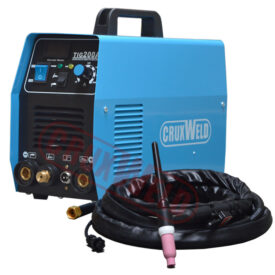 iTIG200DC (TIG 200)Specifications →
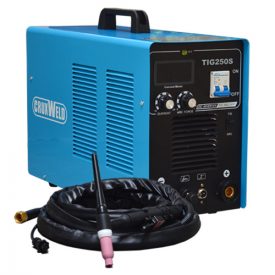 iTIG251DC (TIG 250)Specifications →
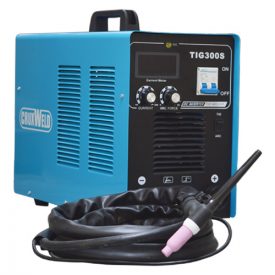 iTIG301DC (TIG 300)Specifications →
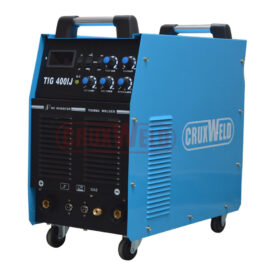 CWTIG400iJSpecifications →
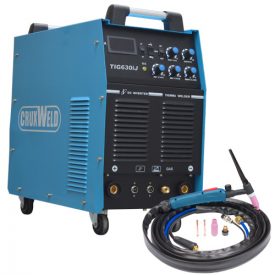 TIG 630Specifications →
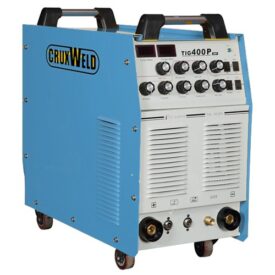 TIG 400P pulseSpecifications →
Open your model for its specifications; the spares page lists the consumables for it.
If the machine runs but the weld or cut is wrong, the cause is usually settings, consumables or the material. Start here:
Running an air-cooled torch at its limit for long seams is the most common reason a TIG machine “overheats”; the torch, not the machine, is the limit. The TIG range page shows which models come with a water-cooled torch.
Send a photo of the weld or cut, your machine model, consumable and plate thickness. Our technical team replies on WhatsApp with the likely causes and the next checks to make.
45+ years of welding expertise · GeM Registered OEM Manufacturer · Supported Worldwide

