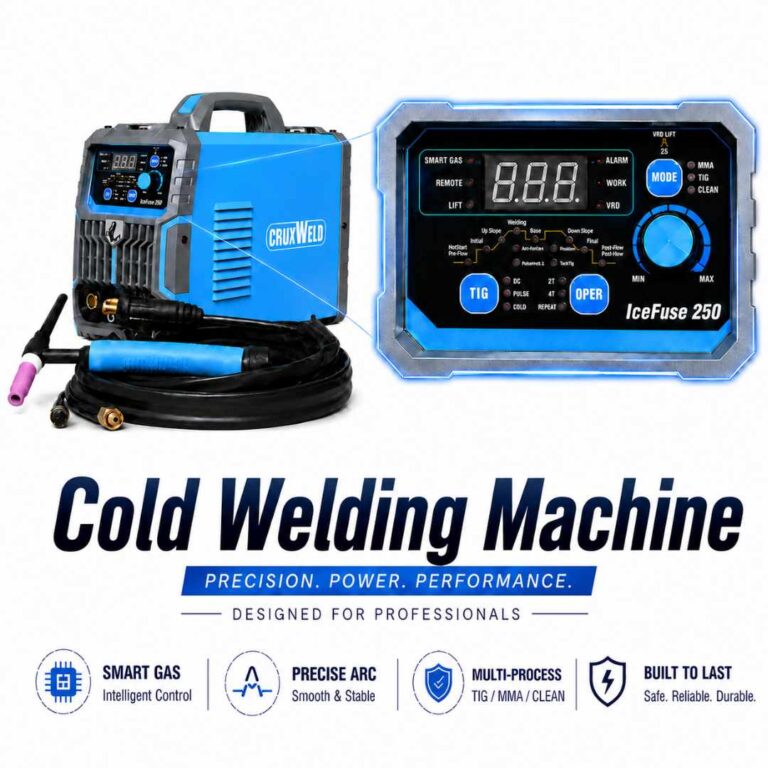
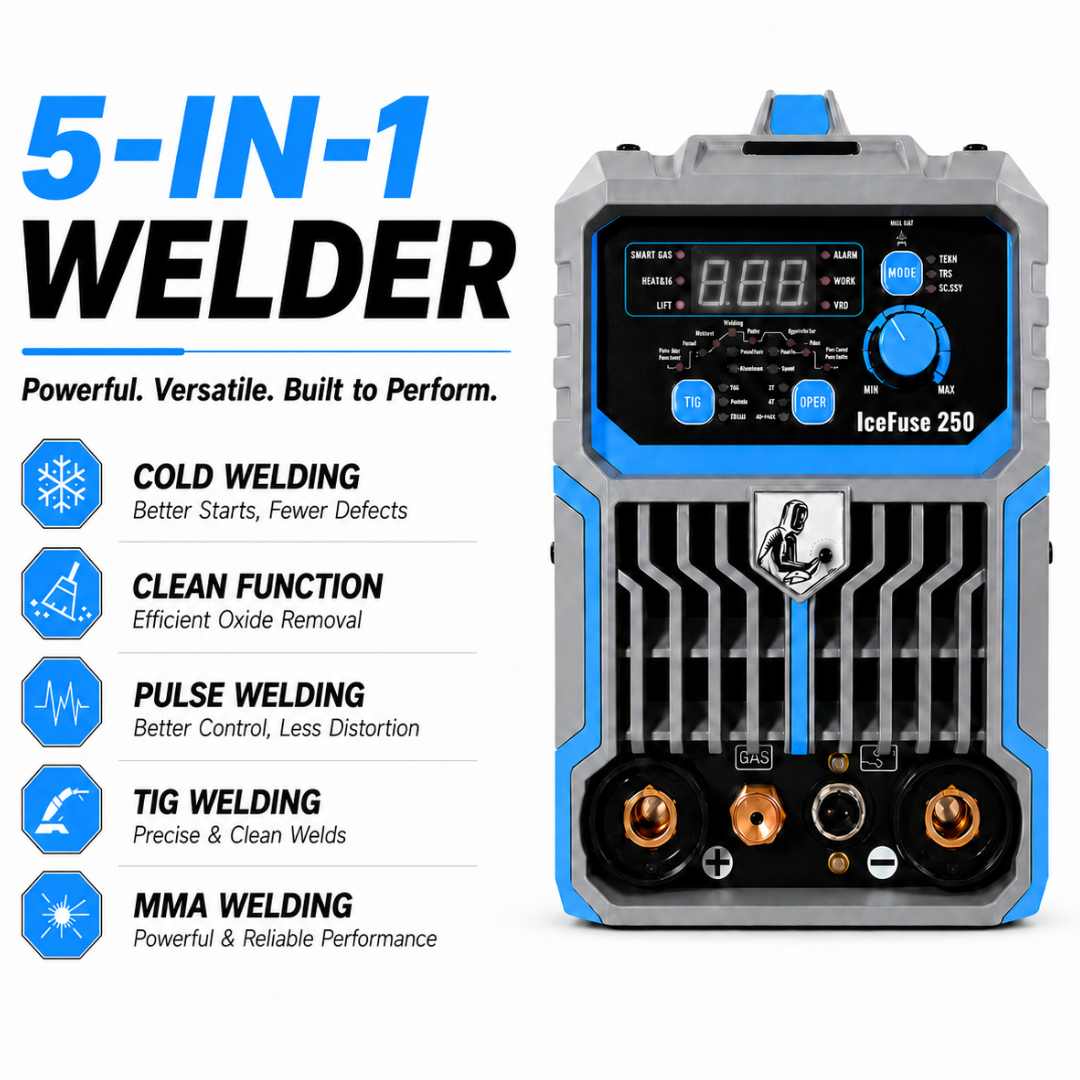
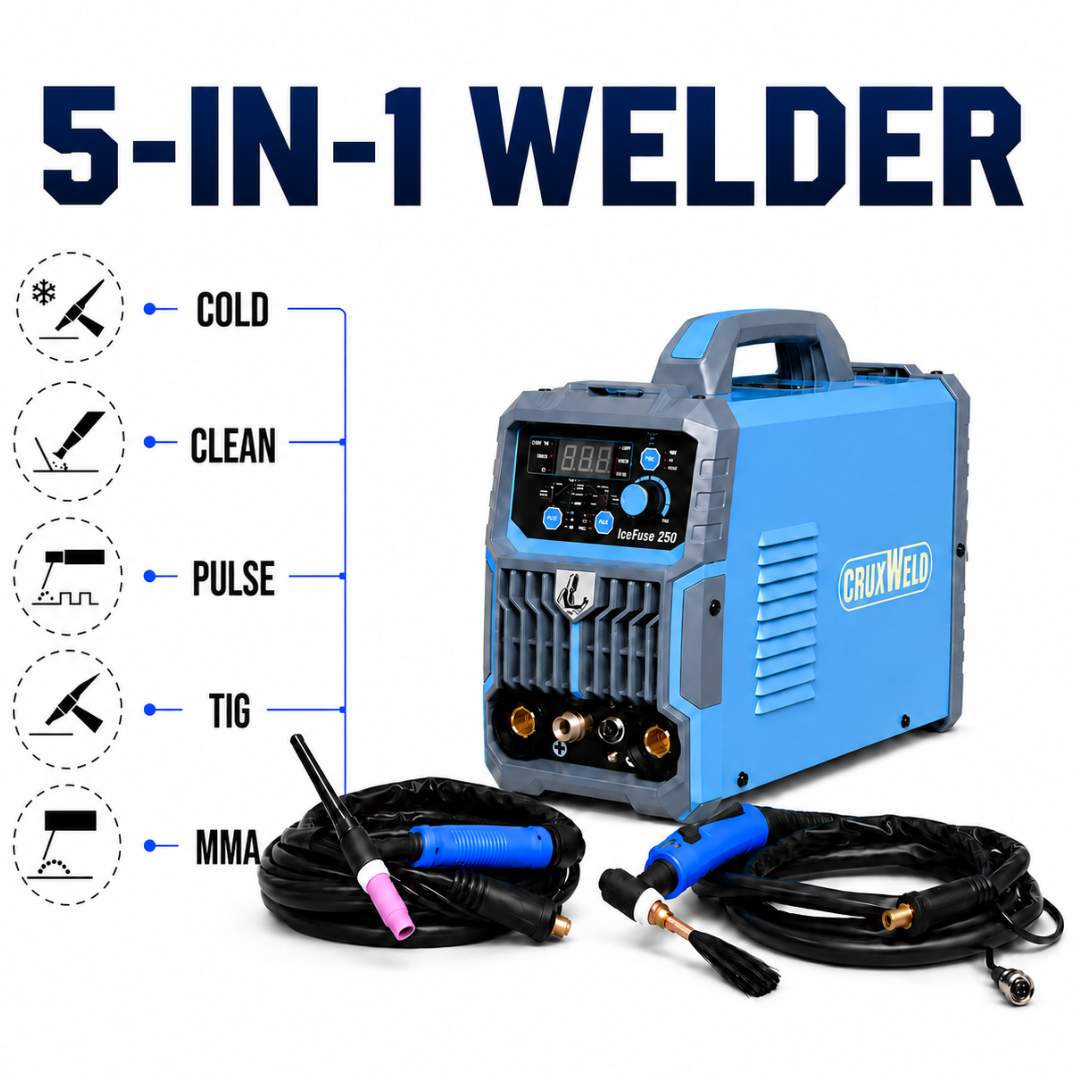
How a cold welding machine keeps thin sheet flat and bright, and why the IceFuse 250 replaces five machines in one.
0.1 mm
thinnest sheet
5-in-1
welding modes
250 A
max current
Thin stainless steel is one of the hardest materials to weld well. Put too much heat into a 0.5 mm sheet and it warps, burns through or turns blue and brown around the joint. Every one of those problems means grinding, polishing or a rejected part.
A cold welding machine solves this by feeding heat into the joint in tiny, timed doses instead of a continuous arc. Here is how it works, where it beats ordinary welding, and how the CRUXWELD IceFuse 250 handles thin-sheet work alongside TIG, pulse, weld cleaning and stick welding.
Why thin stainless steel is so hard to weld
The problem
Stainless steel conducts heat slowly and expands a lot when hot. With a continuous MIG, stick or standard TIG arc, heat builds up around the joint faster than it can spread away. The result is one of these three familiar defects:
Distortion
The hot zone expands, then shrinks as it cools, pulling the panel out of flat.
Burn-through
On sheet below about 1 mm, a steady arc can melt straight through.
Heat tint
Rainbow and brown oxide around the bead that must be removed afterwards.
How a cold welding machine controls heat
How it works
Think of cold welding as a row of precise stitches rather than one long seam. Each short burst of current fuses a small spot, then a pause lets the heat spread out before the next burst. On the IceFuse 250 you set both the weld time (1 to 999 milliseconds) and the interval (0 to 10 seconds).
The result is a flat, bright bead with very little heat-affected zone, even on stainless sheet as thin as 0.1 mm.
Ultra-thin sheet with no warping or discolouration
0.1–6 mm
MODE 2
TIG (HF)
High-frequency arc start for clean, precise TIG welds
0.8–10 mm
MODE 3
PULSE
Fish-scale beads on thin stainless with controlled penetration
0.8–8 mm
MODE 4
CLEAN
Removes heat tint and oxide with a separate cleaning gun
10–50 A
MODE 5
MMA
Stick welding for structural and repair jobs
1.6–4.0 mm rods
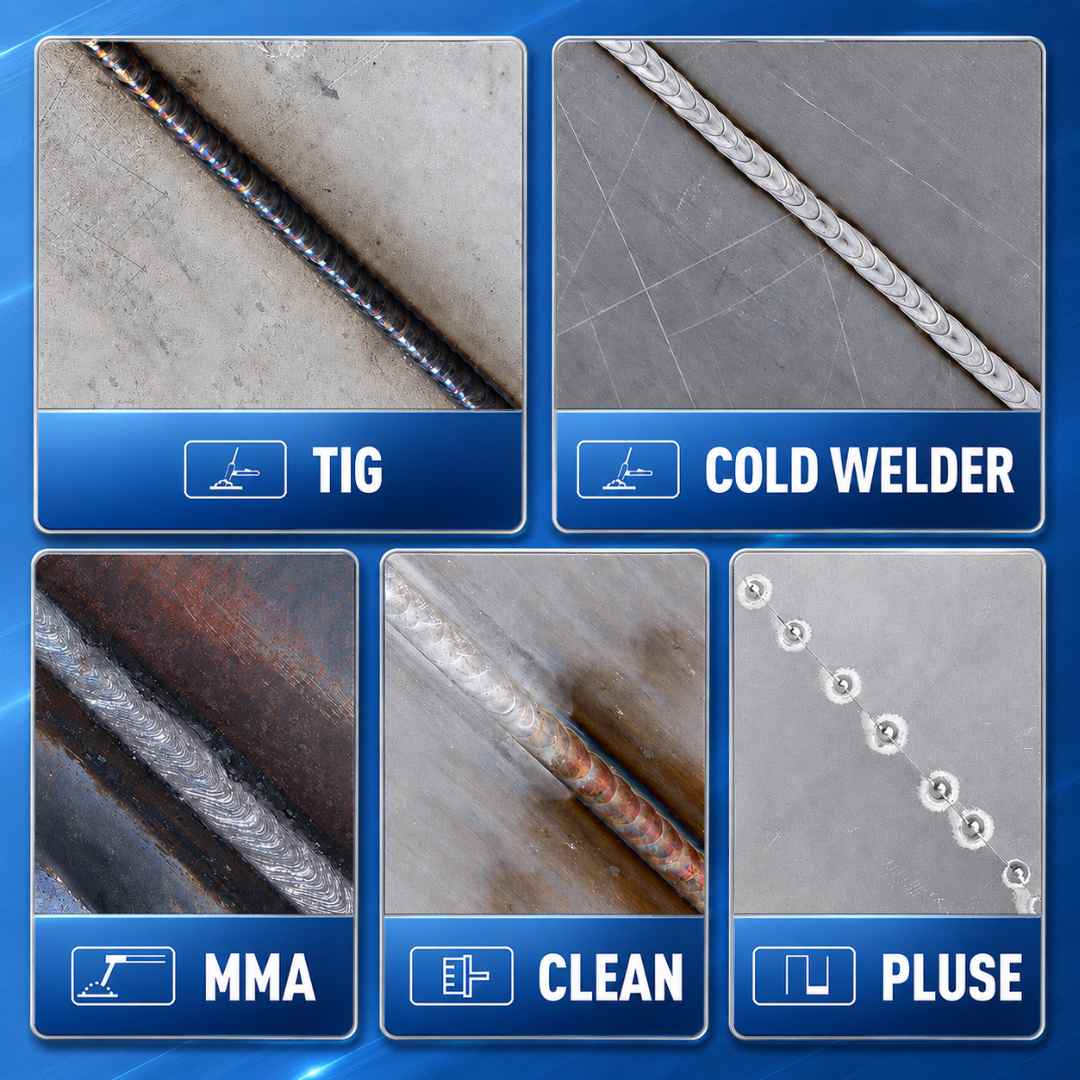
See the difference: bead finish from each IceFuse 250 mode — TIG, Cold, MMA, Clean and Pulse.
Cold welder vs MIG vs standard TIG
Side-by-side
MIG welder
Standard TIG welder
IceFuse 250 cold welder
Heat input
High, continuous
Medium, continuous
Very low, timed bursts
Very thin sheet (0.1–0.5 mm)
Burns through
Difficult
Designed for it
Distortion on thin stainless
Likely
Possible
Minimal
Heat tint around the bead
Heavy
Moderate
Minimal + Clean mode
Post-weld cleaning
Grinding / chemicals
Grinding / chemicals
Built-in cleaning gun
Processes in one machine
MIG
TIG (sometimes MMA)
Cold, TIG, Pulse, Clean, MMA
Comparison for thin stainless sheet work. MIG and TIG remain excellent for thicker sections; the cold welder wins where heat is the enemy.
Clean mode: a bright finish without acids
Finishing
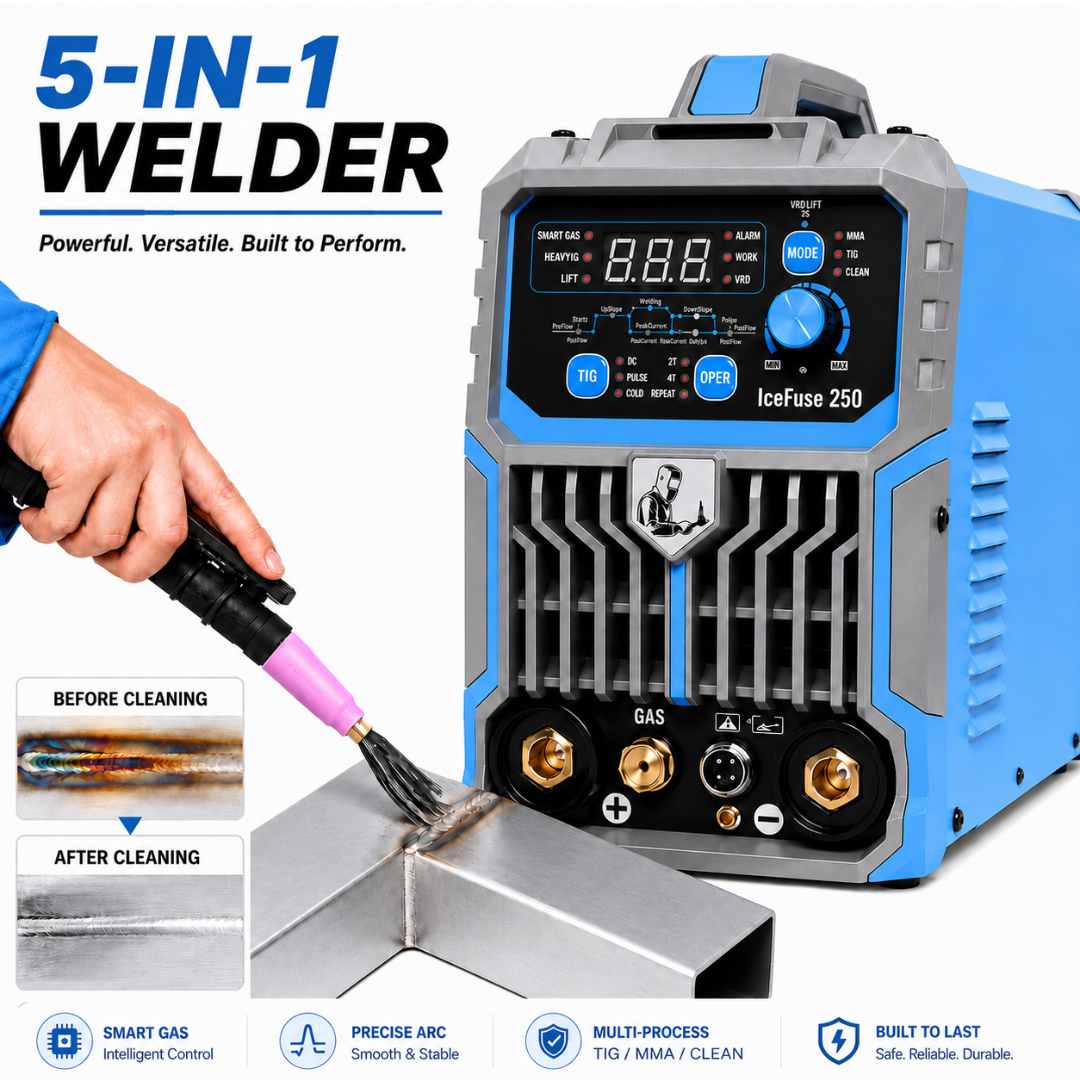
Welding stainless leaves oxide and heat tint. The included cleaning gun runs a gentle 10–50 A cleaning current that wipes the tint away and restores a polished shine — improving both the look and the corrosion resistance of the joint, without pickling paste.
Weld, switch to Clean, and finish the same joint in minutes — no second machine needed.
Before and after: Clean mode removes heat tint from a stainless joint.
How to weld thin stainless steel with cold mode
Step by step
A practical starting point. Always run a few test welds on scrap of the same material and thickness first.
1
Clean the joint
Remove oil, film and dirt from both edges. Contamination shows up immediately on thin stainless.
2
Get a tight fit-up
Thin sheet cannot bridge gaps. Clamp the parts so the edges touch along the whole seam.
3
Choose a fine tungsten
The IceFuse 250 takes 1.0–4.0 mm tungsten. Smaller diameters give a more focused arc on thin sheet.
4
Start with a short weld time
Begin with a short burst and a pause long enough to cool. Increase step by step until the spots fuse fully.
5
Check the shielding gas
Use argon for stainless TIG work. Smart Gas regulates flow to cut argon wastage.
6
Save the settings
Store the parameters in the internal memory so the next batch starts with the same setup.
7
Clean the finished weld
Switch to Clean mode and remove any remaining tint for a bright finish.
GeM Registered OEM Manufacturer · 45+ years of welding expertise
Frequently asked questions
FAQ
Is cold welding a real weld?
Yes. On a machine like the IceFuse 250, cold welding is low-heat fusion welding. The metal melts and fuses into a true metallurgical joint — the heat simply arrives in short, controlled bursts so the sheet stays cool and flat.
How thin can a cold welding machine weld?
The IceFuse 250 cold mode is rated for stainless steel from 0.1 mm up to 6 mm. For thicker sections, TIG, pulse or MMA mode is usually the better choice.
Can I use it for normal TIG and stick welding too?
Yes. It switches between Cold, TIG (HF), Pulse, Clean and MMA modes with up to 250 A, so it also covers everyday TIG work and stick welding with 1.6–4.0 mm electrodes.
Does it run on single-phase power?
Yes. It accepts 220–240 V or 110–120 V single-phase supply, so it suits most workshops and site supplies.
Is it suitable for aluminium?
It is best on stainless steel, mild and carbon steel, galvanised and coated sheet. For heavy aluminium work, a dedicated AC/DC TIG welder is the better match — ask our team and we will suggest the right machine.
Cruxweld makes MIG, TIG, ARC, spot, plasma and automation equipment in India, backed by 45+ years of welding expertise - with spares and WhatsApp support. Call +91 88008 82983 or message us on WhatsApp.
CRAZY IN LOVE WITH WELDING. Ramakant has a diversified background with industrial experience in welding and production management. He holds a master's degree (M.Tech.) in metallurgy and welding technology from SLIET University. He has experience in a number of industries, including power generation, defense, construction, mining equipment, and heavy engineering fabrication. He holds the positions of welding engineer, quality and inspection officer as well as general management. He has written technical welding articles, contributed to the various welding committees. For the past eight years, Ramakant has been a technical consultant, trainer, and spokesperson for Cruxweld.