Troubleshooting guide › Fix it yourself, by machine › AC/DC TIG machines
Everything on the DC TIG page applies here, plus the AC side: balance (cleaning), frequency, and the way aluminium shows up a gas or tungsten problem within seconds. The two questions to answer before calling are: does it weld steel on DC properly, and does the AC mode clean the oxide. The answers point at the fault.
Reviewed by the Cruxweld technical team, October 2026. Settings are starting points to confirm on a test piece; acceptance is decided by the code or drawing the job is built to. Checks marked “call” are for our technical team.
| Indicator | Meaning | What to do |
|---|---|---|
| O.C. / protection lamp on, no output | Over-temperature (60 % duty cycle at maximum current exceeded), over-current, dust-blocked cooling, or supply voltage outside the range | When the protection lamp is on, leave the machine switched on so the fan keeps running. It resets itself when it has cooled. Switching it off makes the wait longer. Blow dust out of the louvres with the machine isolated. If it comes on cold, measure the supply |
| Display off at switch-on | No supply, input connection, internal auxiliary supply | Check the supply and the cable; if present, call |
| VRD active (MMA mode), no-load voltage reads about 9 V | Normal: full voltage appears only when the electrode touches the work | If the electrode will not start on VRD, clean the holder jaws and the earth |
| What you see | Check yourself | If it persists |
|---|---|---|
| Welds steel on DC, but on AC the aluminium oxide is not removed and the pool is dirty | AC/DC switch on AC; AC balance (cleaning) raised; joint brushed with a stainless brush; gas flow | Secondary inverter: call |
| Tungsten burns away or balls up fast | Balance set too far towards cleaning; torch on the + terminal; tungsten too thin for the current; gas flow low | If it still balls with 2 % lanthanated 3.2 mm at 200 A: call |
| Display on, no HF, no arc | Torch switch plug; TIG/MMA switch; remote switch | HF unit: call |
| HF present, no current | Earth clamp connected to the work; torch cable not broken (flex it while pressing the trigger) | Torch cable or output: call |
| Current not adjustable | Remote switch on with nothing connected, or remote plugged in wrongly; pedal potentiometer worn | Panel potentiometer: call |
| Current present, no gas | Nozzle blocked, hose cracked, cylinder empty or closed, solenoid click | Solenoid or gas circuit: call |
| Weld black or grey on aluminium | Post-flow too short, flow low, draught, dirty filler, balance low | See the aluminium guide |
| Arc wanders on AC | Tungsten contaminated or wrong tip shape; raise AC frequency; current too low for the tungsten | See the TIG process page |
| Work cable or plug hot | Loose connection at the machine or the clamp | Tighten; replace a burnt clamp |
| Water-cooled torch hot (400 / 500) | Coolant level, hoses connected and not reversed, pump running, radiator clean | Pump or flow switch: call; never run the torch dry |
A 220 V single-phase machine at full current draws about 30 A; a weak line or a long thin extension drops the voltage below the window and the protection trips. Use the specified 4 mm2 cable and a 32 A breaker, close to the distribution box.
For short welds, yes. For 6 mm and above or long seams, the air-cooled torch overheats before the machine does; the 400 and 500 come with a water-cooled torch for that reason.
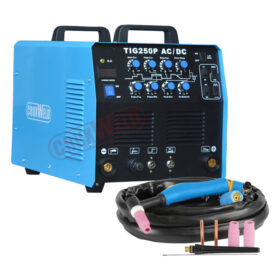 iTIG250ACDCSpecifications →
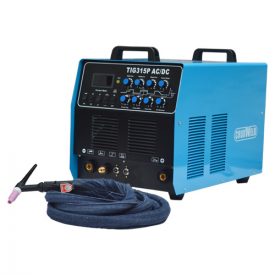 iTIG315ACDCSpecifications →
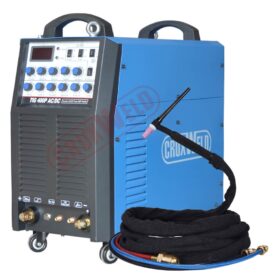 iTIG400ACDCSpecifications →
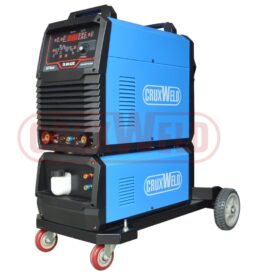 iTIG500ACDCSpecifications →
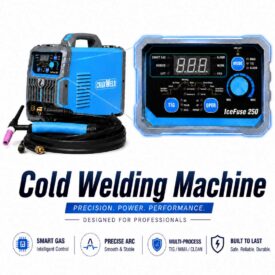 IceFuse 250Specifications →
Open your model for its specifications; the spares page lists the consumables for it.
If the machine runs but the weld or cut is wrong, the cause is usually settings, consumables or the material. Start here:
The iTIG250ACDC is a single-phase 220 V machine and the 315 / 400 / 500 are three-phase 415 V; connecting either to the wrong supply is the one operator mistake that causes real damage. Check the rating plate before the first switch-on at a new site.
Send a photo of the weld or cut, your machine model, consumable and plate thickness. Our technical team replies on WhatsApp with the likely causes and the next checks to make.
45+ years of welding expertise · GeM Registered OEM Manufacturer · Supported Worldwide

