Troubleshooting guide › Fix it yourself, by machine › Stud welding machines and guns
A CD stud welder is a charger, a capacitor bank and a thyristor that dumps the charge through the gun; a drawn-arc machine is a heavy DC source with a timer and a lifting gun. The operator can check the supply, the cables, the gun, the chuck and the settings; the charging and switching circuits are for our technical team. This page is written in that order.
Reviewed by the Cruxweld technical team, October 2026. Settings are starting points to confirm on a test piece; acceptance is decided by the code or drawing the job is built to. Checks marked “call” are for our technical team.
| What you see | Check yourself | If it persists |
|---|---|---|
| Power lamp off | Supply and cord; input fuse (replace with the same rating only); power switch; supply lead seating | Call |
| Charges and discharges repeatedly | Working voltage set too low: set higher; gun trigger not stuck; restart the machine once | Rectifier or control fault: call |
| Power lamp on, will not charge | Nothing outside the cabinet | Charging circuit (diode, transformer, rectifier, control board): call |
| Discharges by itself | Gun trigger switch stuck closed; trigger lead crushed | Thyristor or control board: call |
| Charged (voltage shown) but will not discharge on the trigger | Gun control switch and cable; main cable and earth cable connected; auxiliary wire in the gun barrel; workpiece insulated or corroded at the clamp; all three legs on the work | Main thyristor: call |
| Working voltage cannot be reduced | Knob loose on its shaft | Potentiometer or relay: call |
| Weak weld | Voltage too low; gun pressure too high or too low; stud quality and tip; sheet coated or corroded; sheet outside the usable range | If weak at the right voltage with a clean sheet and a good gun: control board, call |
| Voltage lamp not lit, or not lit but the machine welds | Nothing outside | Indicator or auxiliary transformer: call |
| Slow recharge between studs | Supply voltage low or a long thin extension lead; fan grille blocked and the charger hot | Charger: call |
| Collet or chuck jams, stud will not release | Collet worn or wrong size; spatter inside; lock nut loose | Replace the collet |
| Indication | Meaning | What to do |
|---|---|---|
| E01, overheating lamp | Temperature switch open: duty cycle exceeded | Let it cool with the fan running; space the welds |
| E04, power failure | A supply phase lost | Check the three-phase supply and the breaker |
| Abnormal mains lamp | Supply out of phase or under voltage | Switch off; have the supply checked |
| Contact lamp on | Stud and work short-circuited (normal while the stud touches before lift; a fault if it stays on with no weld) | Check the gun lifts; free a stud welded from the previous attempt; check the control cable |
| Output stops after about 10 s in manual mode | Normal no-load timeout | Nothing |
| Fan stops after about 10 minutes idle | Normal; restarts on any switch operation | Nothing |
| Weld time or current not as set | Panel in the wrong mode (manual / automatic, stud / manual welding, torch test / welding) | Select the mode; check parameter P06 (automatic re-ignition) is as intended |
| Gun does not lift, or lift varies | Gun shaft dry or dirty; control cable; lift setting | Clean and lubricate the front shaft with the specified silicone oil; call if the lift solenoid does not act |
| Weak or one-sided collars at the set current | Earth position (arc blow), plate condition, ferrule, lift, extension | See the drawn-arc page |
| Emergency stop pressed | Power shut down | Release and restart |
Yes. The capacitor bank holds a lethal charge after switch-off and must be discharged by a technician before any internal work. There is nothing inside the operator needs.
Check the voltage for M10 (160-180 V on the CDS series) and that the display reaches it; a weak supply or a long extension lead can stop the charger reaching the top of the range. If the voltage is reached and the weld is still weak, the sheet is too thin for M10 or the gun pressure is wrong.
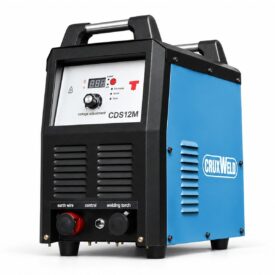 CDS12M CD stud welderSpecifications →
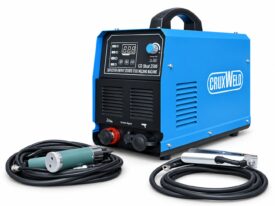 Capacitor discharge stud welderSpecifications →
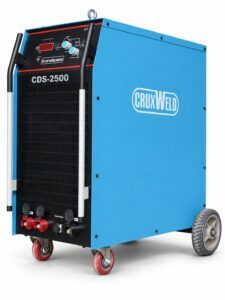 Drawn-arc stud welderSpecifications →
Open your model for its specifications; the spares page lists the consumables for it.
If the machine runs but the weld or cut is wrong, the cause is usually settings, consumables or the material. Start here:
A CD machine that welds weakly at the right voltage with a clean sheet and a good gun needs its capacitor bank or control checked; that is a workshop job. A drawn-arc machine that cannot hold the set current is usually the supply or the cables.
Send a photo of the weld or cut, your machine model, consumable and plate thickness. Our technical team replies on WhatsApp with the likely causes and the next checks to make.
45+ years of welding expertise · GeM Registered OEM Manufacturer · Supported Worldwide

