Troubleshooting guide › Fix it yourself, by machine › FINELINE plasma cutters
Four things make a plasma cutter work: air, consumables, the work clamp and the supply. Nine out of ten “it will not cut” calls are one of the first three. This page covers the hand-held and CNC-capable FINELINE inverters from 40 A to 200 A, including the 40C and 100IC with built-in compressor.
Reviewed by the Cruxweld technical team, October 2026. Settings are starting points to confirm on a test piece; acceptance is decided by the code or drawing the job is built to. Checks marked “call” are for our technical team.
| Indicator | Meaning | What to do |
|---|---|---|
| POWER off with the switch on | No supply, phase missing, indicator, switch or breaker | Check the supply and the breaker; if present, call |
| OVER-TEMPERATURE on | Duty cycle exceeded, thermal switch, blocked air path | When the protection lamp is on, leave the machine switched on so the fan keeps running. It resets itself when it has cooled. Switching it off makes the wait longer. Clear the louvres |
| Under-voltage / over-voltage protection | Supply outside the window | Measure the supply under load; a long thin extension lead on a single-phase model is the usual cause |
| Air pressure lamp or no gas flow with POWER on | Air supply, regulator, solenoid, control board | Set the regulator to about 4.5 bar with air flowing; drain the filter; if the solenoid does not click: call |
| Red diode / HF indicator on, no pilot arc | HF arc-starter circuit fault | Dry the torch and consumables (humid night), check the torch plug; then call |
| What you see | Check yourself | If it persists |
|---|---|---|
| Trigger does nothing, fan runs | Shield cup fitted and tight (interlock); torch plug and trigger lead; air pressure present | Torch switch or control: call |
| Pilot arc fires, no transferred arc on the plate | Electrode and nozzle not touching each other (worn or wrongly fitted); work clamp on clean metal; torch 2-3 mm from the plate at start | HF gap, arc-start board or output diode: call |
| Cuts for a few seconds, then stops | Air flow too small so pressure drops (gauge falls while cutting); work cable contact; compressor cycling | Bigger compressor or receiver; if air is steady: call |
| Kerf widened or deflected, arc wanders | Electrode or nozzle worn; cutting speed (too fast deflects, too slow widens); torch head bent or parts not aligned | Replace the torch head |
| Torch parts burn out quickly | Moisture or oil in the air (fit a dryer, drain daily); shield cup not tightened; piercing too low; dragging the nozzle at full current; too many pilot starts in the air | If parts still fail in hours with dry air: call |
| Cut does not go through, arc blows back | Speed too high; current too low; plate beyond the quality-cut thickness; worn electrode | See the plasma cutting page |
| Edge rough, intermittent cut | Wet air; pressure fluctuating; swirl ring damaged | Fit a refrigerated dryer |
| Built-in compressor (40C / 100IC) runs but pressure low | Intake filter blocked; drain valve open; hose leak; compressor overheated from continuous use | Compressor service: call |
| Built-in compressor does not start | Compressor switch; thermal cut-out (wait 15 minutes) | Call |
| Machine cuts well on 6 mm, badly on 12 mm | Current at maximum; speed from the table; consumables for the current; air flow at full current | The plate may be above the clean-cut rating for the model |
| CNC: arc starts but machine does not move; THC faults | Arc-transfer signal cable to the controller; divider board setting | See the CNC cutting page |
Look at the hafnium insert in the centre: a pit deeper than about 1.5 mm, or off-centre, means it is done. Cutting speed drops, the kerf widens and the arc starts badly at the same time.
It is sized for the machine’s rating in hand cutting. For continuous CNC cutting at full current an external compressor with a receiver and dryer keeps the pressure steadier.
The built-in compressor runs within the machine’s duty cycle for hand cutting; on long continuous cuts or CNC use the compressor heats and the pressure sags, so connect external dry air for production work. Drain the moisture trap every shift (twice a day in the monsoon); wet air from a hot compressor is the main cause of short consumable life on these models.
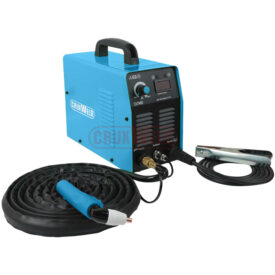 FINELINE 40Specifications →
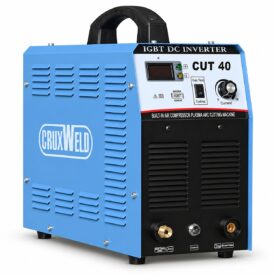 FINELINE 40C built-in compressorSpecifications →
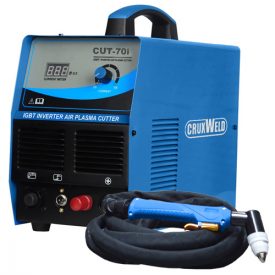 CUT 70Specifications →
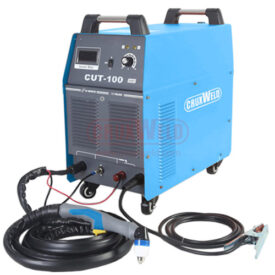 FINELINE CUT-100Specifications →
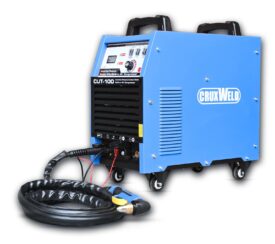 FINELINE 100IC built-in compressorSpecifications →
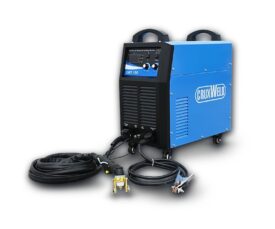 FINELINE 120Specifications →
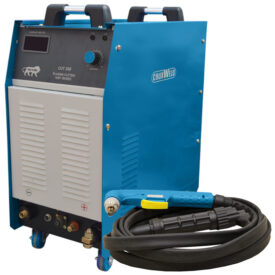 FINELINE CUT-160Specifications →
Open your model for its specifications; the spares page lists the consumables for it.
If the machine runs but the weld or cut is wrong, the cause is usually settings, consumables or the material. Start here:
If the consumables are new, the air is dry and at pressure, and the machine still cannot cut the plate thickness you need cleanly, the machine is too small for that plate: as a rule about 1 mm of mild steel per 6-7 A for a clean cut. The finder shows the next size.
Send a photo of the weld or cut, your machine model, consumable and plate thickness. Our technical team replies on WhatsApp with the likely causes and the next checks to make.
45+ years of welding expertise · GeM Registered OEM Manufacturer · Supported Worldwide

