Troubleshooting guide › Fix it yourself, by machine › MIG welding machines
Most calls we get about MIG machines are cleared in five minutes by the operator: a missing phase, a loose work clamp, an empty cylinder, a worn tip, a blocked air inlet. This page lists what the machine is telling you through its lamps, what to check in order, and the point at which to stop and message us. It covers the inverter iJ series with separate feeder, the compact MIG300iW and MIG250iW with built-in feeder, the water-cooled MIG500P, and the older thyristor and diode MIG sets.
Reviewed by the Cruxweld technical team, October 2026. Settings are starting points to confirm on a test piece; acceptance is decided by the code or drawing the job is built to. Checks marked “call” are for our technical team.
| Indicator | Meaning | What to do |
|---|---|---|
| POWER off, fan off, no display | No supply, phase missing, rear breaker open, input fuse, or control transformer | Check the isolator and all three phases; close the rear breaker once; if it will not stay closed, call |
| POWER on, PROTECTION / ALARM on, no output | Over-temperature (duty cycle exceeded, blocked air path, ambient over 40 degrees C) or mains over-voltage | When the protection lamp is on, leave the machine switched on so the fan keeps running. It resets itself when it has cooled. Switching it off makes the wait longer. Clear the louvres. If it trips every few minutes, the job is beyond the duty cycle |
| ABNORMAL / FAULT on | Internal fault detected by the control board | Switch off, wait 1 minute, switch on once. If it returns, call with the lamp pattern |
| Rear breaker trips at switch-on | Internal component failure | Do not keep resetting; call |
| Rear breaker trips during welding | Duty cycle exceeded, or the breaker itself is weak | Reduce current or add rest time; if it trips under light load, call |
| Fan not running | Fan or its capacitor, or on some models the fan starts only when welding begins | Weld for 10 s and watch; if it never runs, stop welding (the machine will overheat) and call |
| CO2 heater cold, regulator frosting | Heater fuse blown, heater cable, or heater element | Check the heater plug on the rear panel; the heater fuse is a user-replaceable fuse on most models; otherwise call |
| What you see | Check yourself | If it persists |
|---|---|---|
| Trigger pressed: no wire, no gas, no voltage | Torch plug fully home in the feeder; control cable between feeder and machine seated at both ends, pins clean and straight; MIG/MMA selector on MIG | Torch trigger switch or control board: call |
| Wire feeds but no gas | Cylinder valve, contents, flow meter, hose end to end, solenoid click when the trigger is pressed | Solenoid or control board: call |
| Gas flows but no wire | Feed roll pressure arm closed, spool brake not locked, wire not jammed at the inlet guide, DC supply plug to the feeder motor seated | Feed motor or feeder board: call |
| Wire feeds unevenly, birdnests, burns back | Liner blown out or replaced, tip size and wear, roll groove, roll pressure, spool brake, torch cable not coiled, burnback time setting | Feeder motor speed control: call |
| Arc will not strike | Earth clamp and cable, contact tip conducting, output lugs tight, wire end cut clean | Output circuit: call |
| Arc unstable, heavy spatter | Voltage matched to wire speed, tip worn, earth poor, one phase missing (arc weak and machine humming), gas flow | If the arc wobbles with a steady voltmeter: call |
| Current will not reach the set value | Supply voltage under load, cable size and length to the machine, long stick-out, poor earth | Hall sensor or control board: call |
| Current cannot be adjusted | Remote/local selector, feeder control cable seated, knob not loose on its shaft | Potentiometer or board: call |
| Porosity suddenly on a machine that was fine | Gas (contents, flow, leaks), nozzle, draught, wet plate, heater on CO2 | See the porosity page |
| Machine stops after 20-30 minutes, restarts after a rest | Duty cycle, air inlets, ambient temperature, fan running | If it stops at low current with a clean machine: thermal switch, call |
| Water-cooled torch very hot, little coolant return (MIG500P) | Coolant level between the marks, hoses connected and not reversed (colour to colour), hoses not kinked, pump running, radiator clean | Pump or flow switch: call. Never weld with the tank empty; the torch is destroyed in seconds |
| Earth cable or output plug hot | Lug or dinse plug loose, clamp face burnt, cable too small | Replace the clamp or cable; a hot connection is a fire risk |
Yes, on a generator rated at least 1.5 times the machine input kVA with stable voltage. A small or worn generator gives an unstable arc and trips the over-voltage protection.
Then it is the supply: mains over-voltage or a phase imbalance, not temperature. Measure the supply at the isolator with the machine running.
Contact tips (a box of each size you use), two nozzles, a diffuser, a liner, a set of feed rolls, an earth clamp, and the CO2 heater fuse. The spares page has the list for your model.
Single pulse for most steel and stainless work (spatter-free spray at lower average current); double pulse for aluminium and for a TIG-like ripple on visible stainless seams. A program chosen for the wrong wire or gas shows as an unstable, spitting arc and a bead that will not wet: re-select the program for the wire diameter, material and gas before touching the trim. For aluminium fit the push-pull torch or a spool gun, a PTFE liner and U-groove rolls.
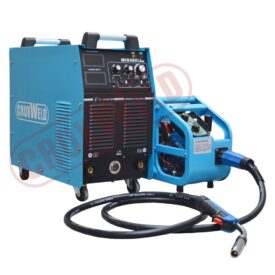 CWMIG400iJSpecifications →
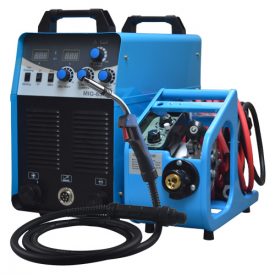 CWMIG600iJSpecifications →
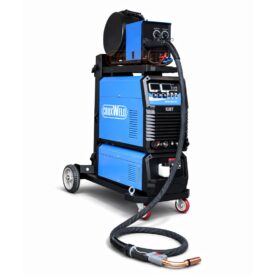 MIG500P water cooledSpecifications →
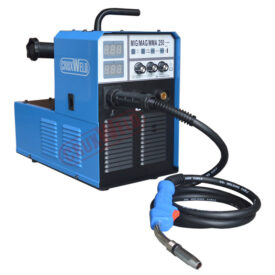 MIG250iWSpecifications →
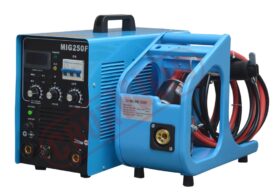 MIG 250Specifications →
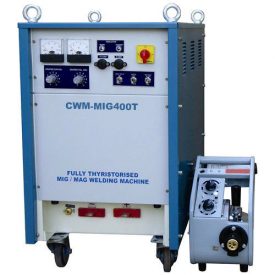 Thyristor MIG 400Specifications →
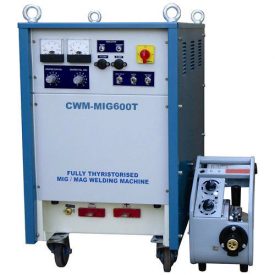 Thyristor MIG 600Specifications →
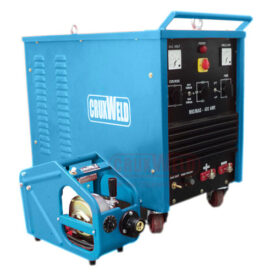 Diode MIG 250 / 400 / 600Specifications →
Open your model for its specifications; the spares page lists the consumables for it.
If the machine runs but the weld or cut is wrong, the cause is usually settings, consumables or the material. Start here:
If the checks on this page keep ending in “call service” for the same machine, it is usually being run past its duty cycle or on a weak supply line. The product finder shows the size that runs your plate continuously.
Send a photo of the weld or cut, your machine model, consumable and plate thickness. Our technical team replies on WhatsApp with the likely causes and the next checks to make.
45+ years of welding expertise · GeM Registered OEM Manufacturer · Supported Worldwide

