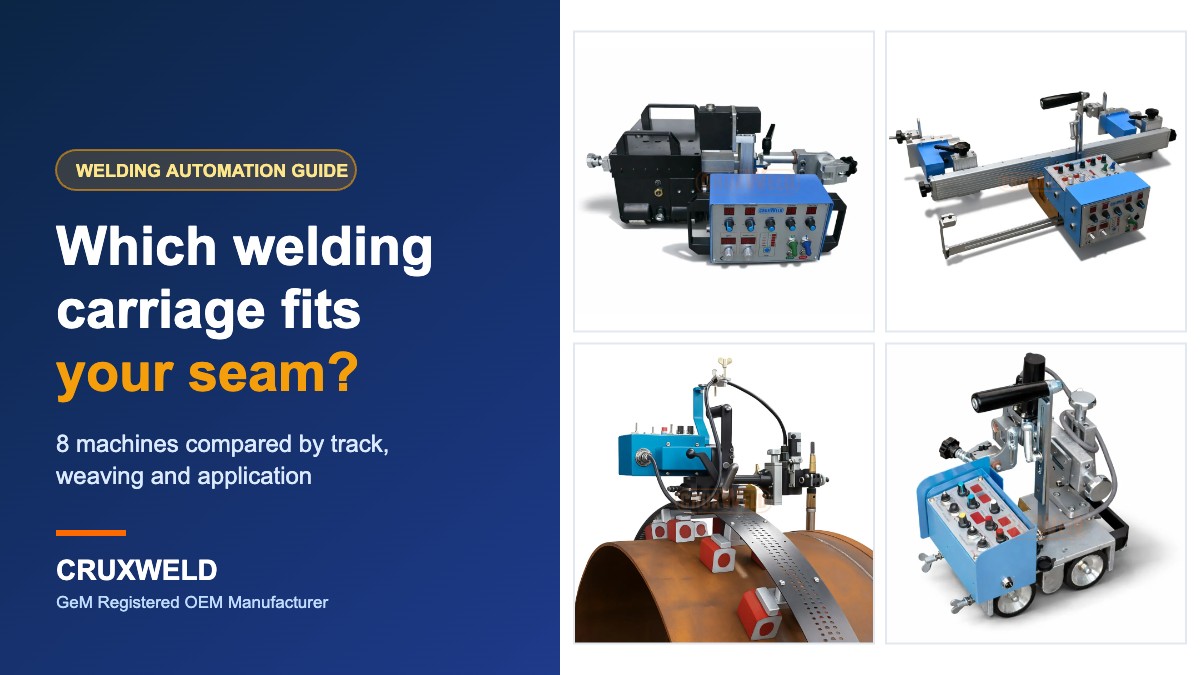
Eight Cruxweld automation machines compared by track type, weaving, speed and application — so you buy the one your joints actually need.
8
machines compared
4
questions to decide
7
demo videos
On a long seam, a weld rarely goes wrong because the welder lacks skill. It goes wrong because travel speed drifts, the torch angle wanders and the weave changes width after a few hours of tiring work. A welding carriage takes those three variables out of the operator’s hands: it carries the torch at a set speed, holds the angle and, on oscillating models, repeats the same weave on every pass.
A carriage does not replace your welding machine. It mechanises motion; the arc still comes from your MIG, TIG or SAW power source and your qualified welding procedure. That makes automation one of the quickest upgrades a fabrication shop can make — but only if the carriage matches the joint. This guide shows you how to choose.
Manual welding vs a welding carriage
What actually changes
Manual welding
Travel speed set by hand, changes over a long pass
Weave width depends on the operator and on fatigue
Welder stays close to arc heat and fumes
Output limited by how many certified welders you have
Mechanised with a carriage
Set travel speed held over the full seam
Programmed weave repeats on every pass and every shift
Operator supervises from a distance (WeldOrbit 360 has a 20 m remote cable)
Basic machine operation instead of hand travel skill
Indicative ranges published for the DynaTwin 200M. Real output depends on joint type, thickness, fit-up and your WPS.
4 questions that decide the right carriage
Start here
01
What path does the seam follow?
Straight seams, circular seams on tanks and pipes, or a small circle around a tube end each need a different machine.
02
Do you need a weave?
Narrow fillets run fine with a straight pass. Wide fillets, grooves and cap passes need oscillation for even side-wall fusion.
03
Rail, trackless or flexible track?
Rails give slip-free travel on vertical and overhead work. Trackless carriages skip setup. A flexible track bends around any diameter.
04
Weld only, or cut and bevel too?
Some carriages take a plasma or oxy-fuel torch, so one machine also handles edge preparation and circle cutting.
DynaSwing 100K: rack & pinion drive on a permanent-magnet rail
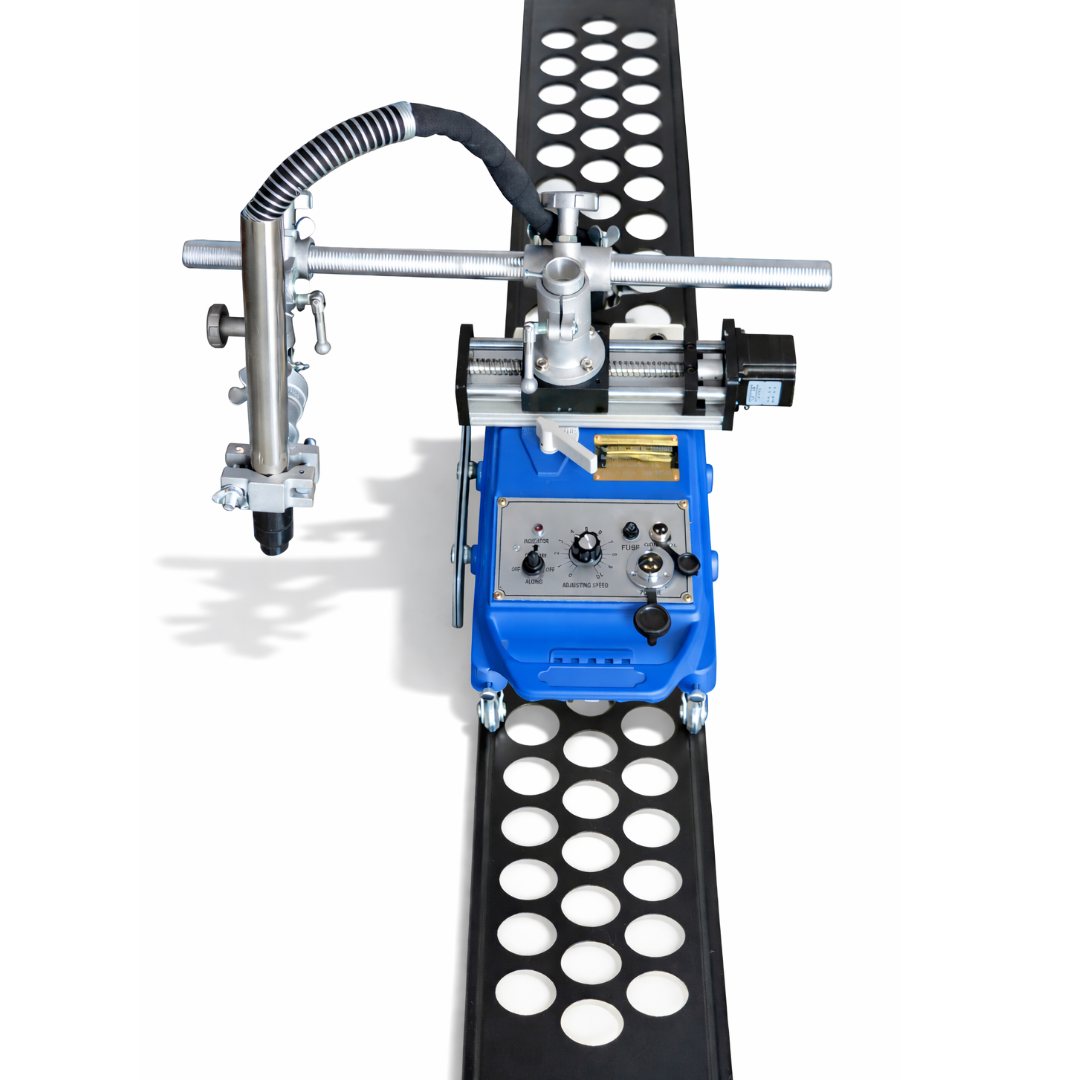
DynaMove 45K: extendable rail for long weld and cut runs
Best when the carriage must never slip on a vertical seam
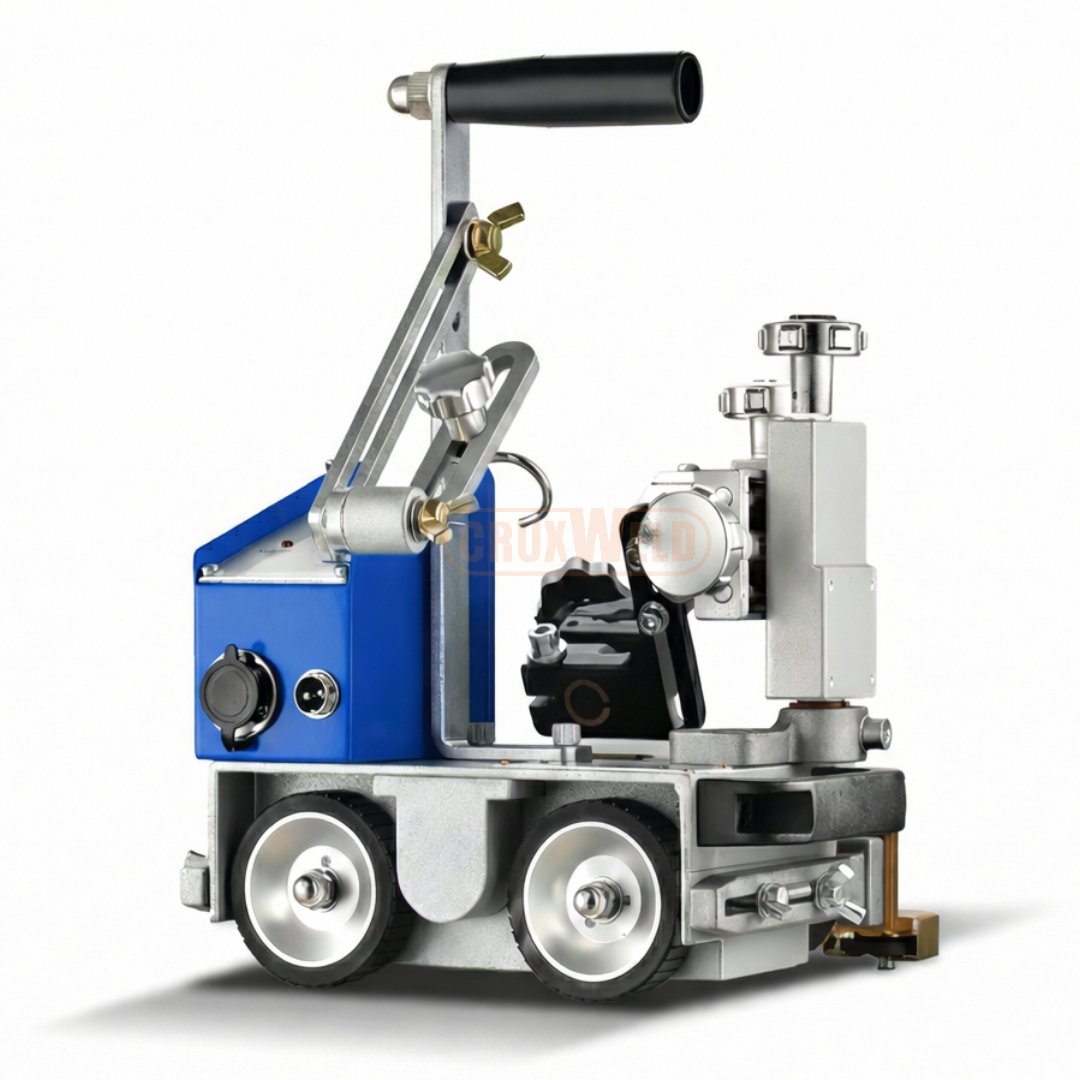
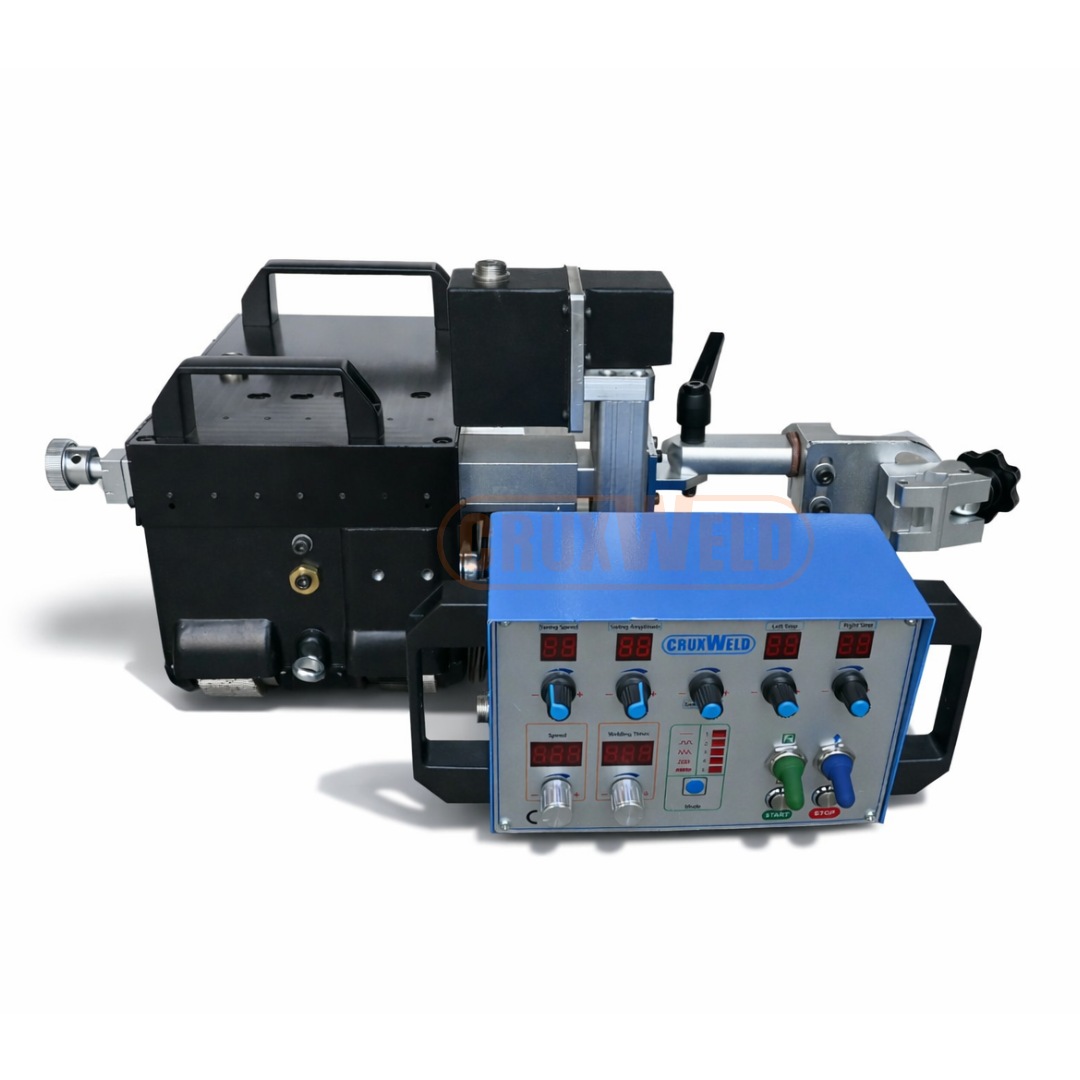
Trackless magnetic
Place it on steel and start
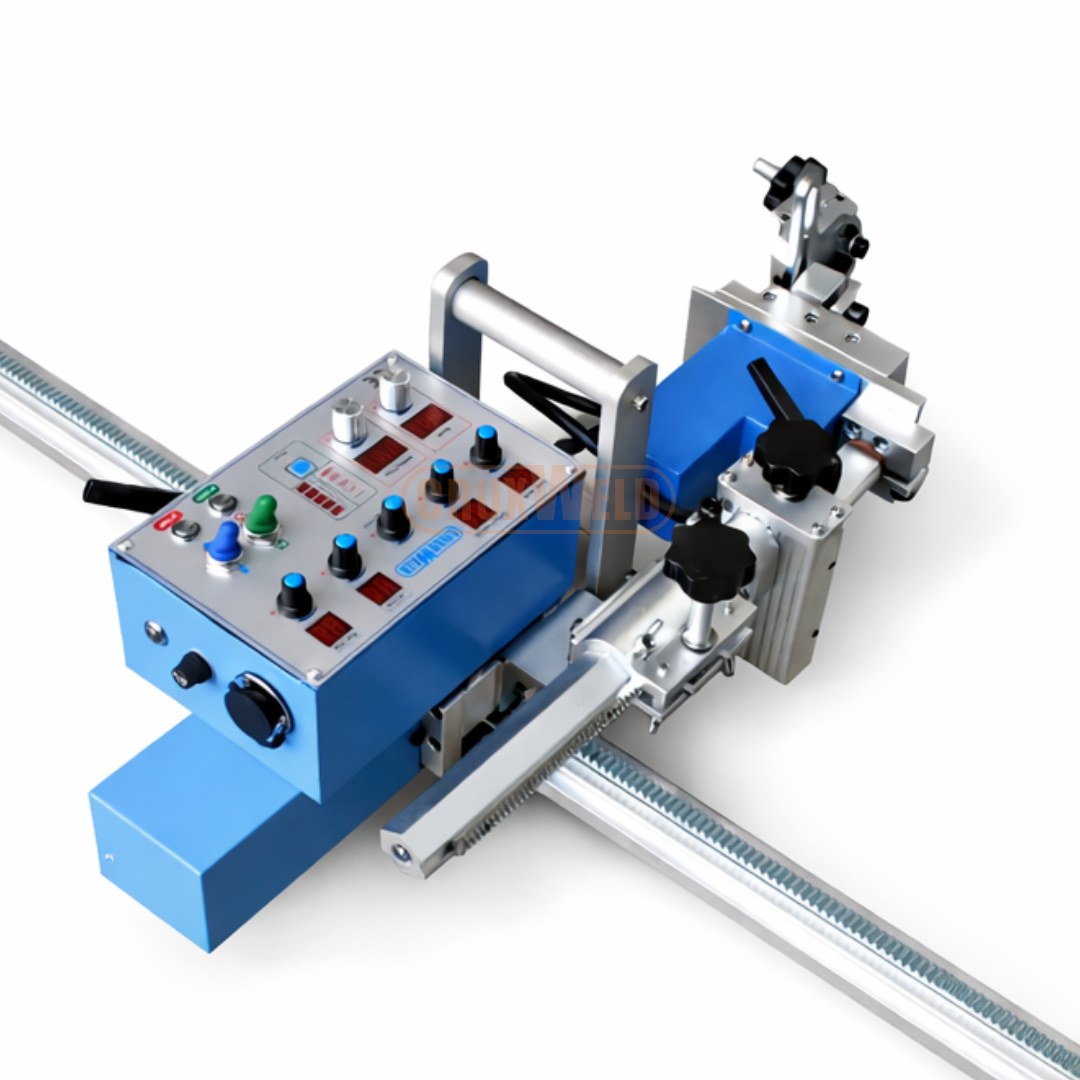
WeldyFi, Dynex 5M, DynaTwin 200M, WeldOrbit 360
No rail to lay or move between joints
Magnets need a steel (ferrous) surface to hold on
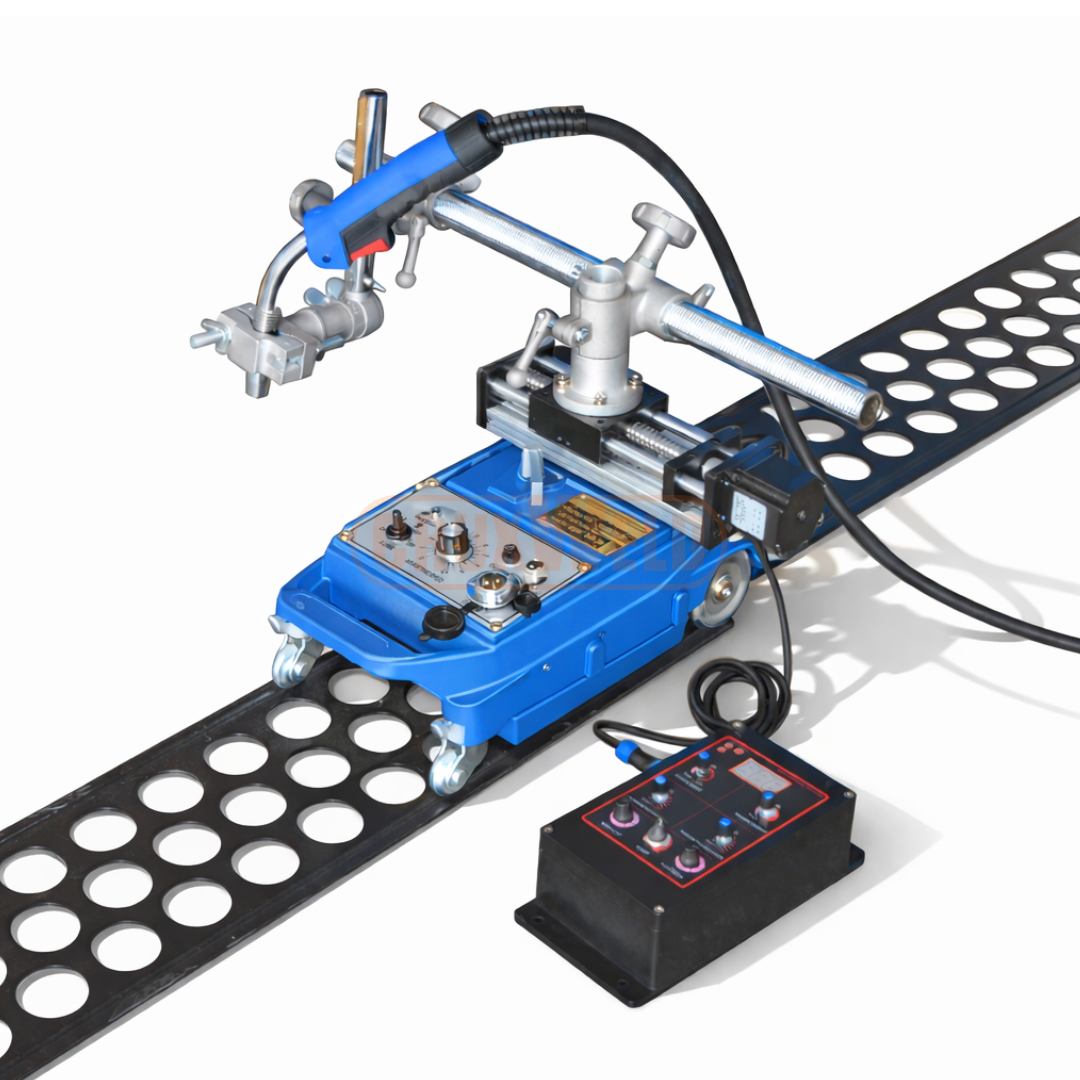
Flexible magnetic track
Bends to any diameter
DynaFlex 100S: spring-steel track, 1.8 m segments that link together
Circumferential and vertical seams on tanks and vessels
No custom fixture for each diameter
Weaving patterns: which one for which pass?
Question 2, explained
Oscillation moves the torch side to side while the carriage travels. The pattern decides where the heat goes. Most Cruxweld oscillating carriages offer several patterns, with adjustable width, speed and a dwell time at each edge (0–2.5 s on WeldOrbit 360, DynaSwing 100K and Dynex 5M) so the weld toes fuse properly.
Straight (no weave)
Narrow fillets and stringer beads.
Triangle / zigzag
Root passes and wider fillets — good side-to-side coverage.
Trapezoid / square wave
Even heat for flat, uniform beads and groove side walls.
Circular
Curved surfaces and pipe-like geometry (Dynex 5M).
Wave / multi-step
Wide cap passes and multi-pass work on thick plate.
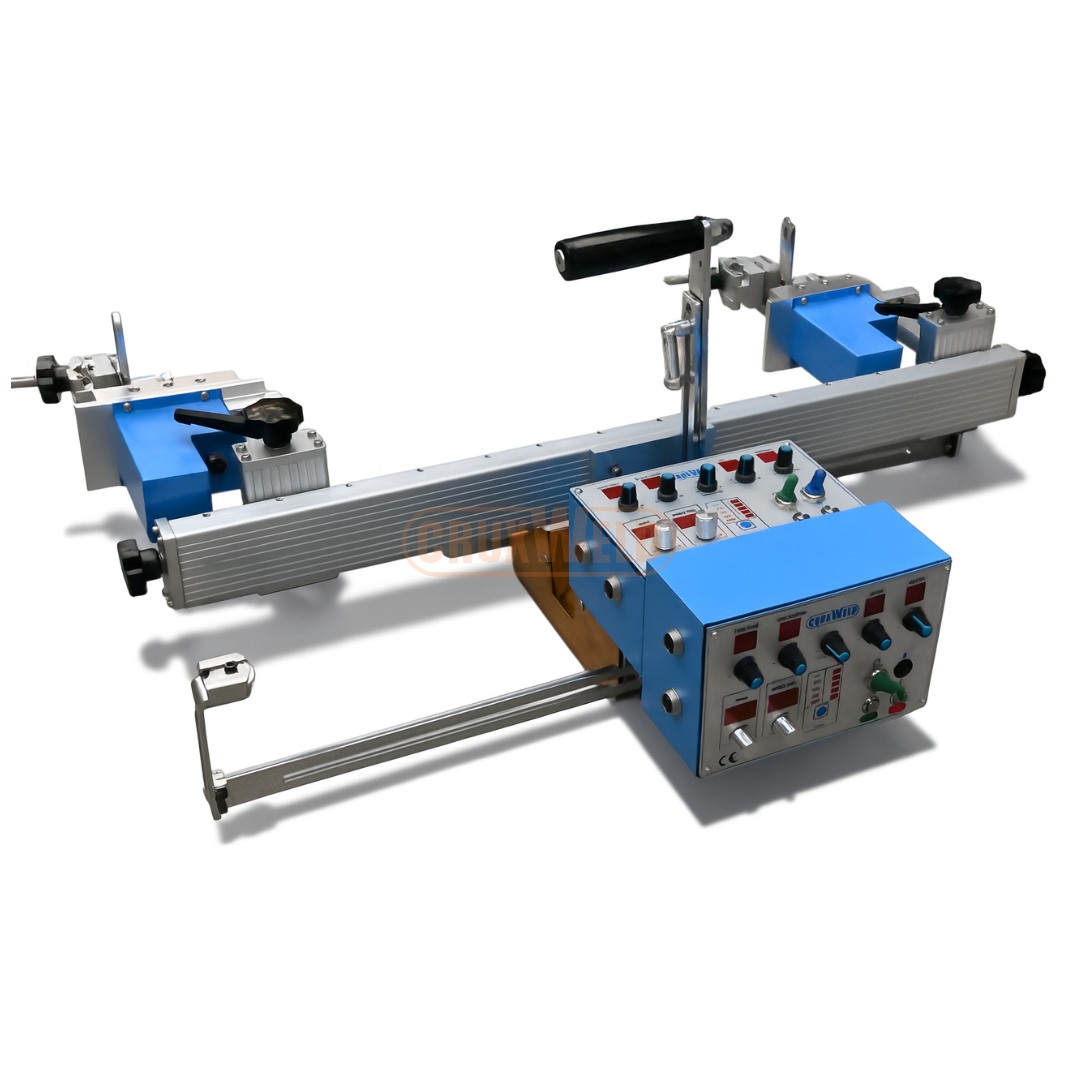
Linear oscillator on the DynaMove 45K.
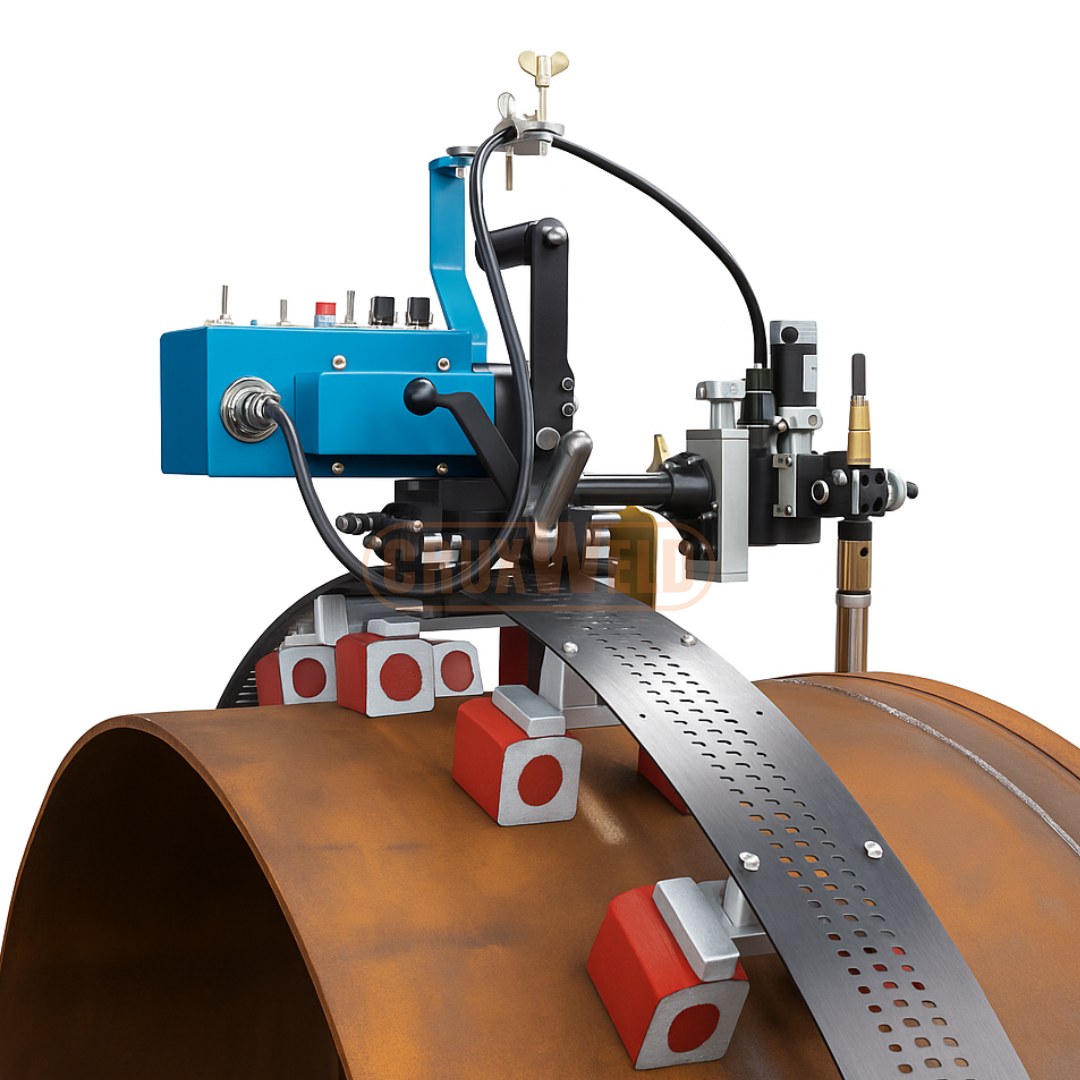
Linear vs pendulum oscillation. Most carriages move the torch in a straight side-to-side line. The WeldOrbit 360 instead swings the torch in a radial arc around a pivot — the same “walking the cup” motion skilled pipe welders use. It puts more heat into the weld toes on deep grooves and flange-to-pipe joints.
Pick by application: the quick map
Your job → your machine
Long straight fillets on beams, stiffeners and frames
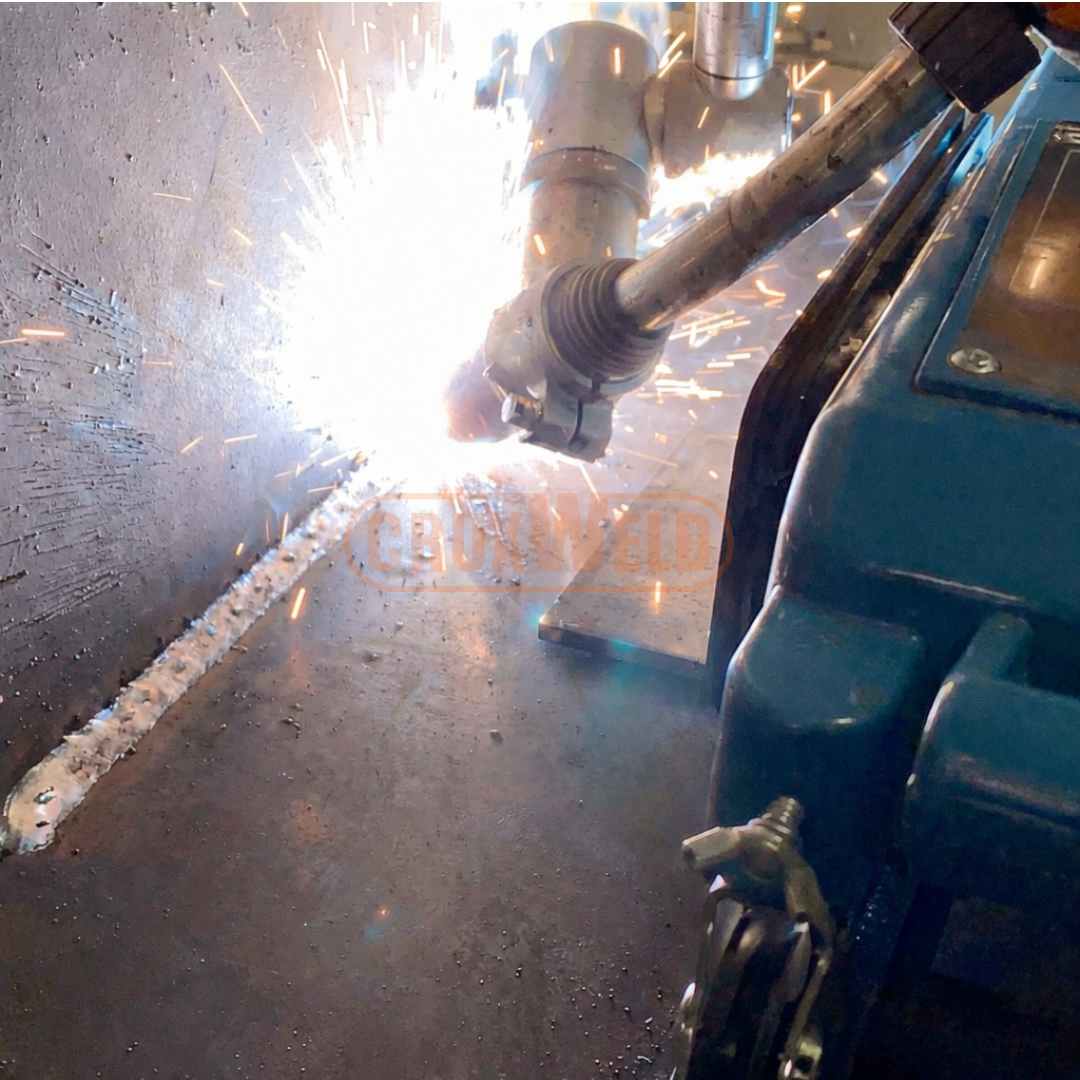
Trackless, rolls on fillet guide rollers, 5–1100 mm/min. Quick to place on joint after joint.
These three ride directly on the steel workpiece. No rail to lay, so you move from joint to joint quickly — ideal for structural yards, shipbuilding stiffeners and beam lines.
Trackless fillet
WeldyFi
5–1100 mm/minFillet guide rollersMIG/MAG & FCAWCrater fill
Best for: straight fillets on I-beams, H-beams, girders, tanks and pressure vessels; stitch welding.
Rail carriages for vertical work and weld-plus-cut jobs
Family 2 · Rail-guided
A rail costs a few minutes of setup but gives the steadiest travel there is. Choose this family when the seam climbs a wall or runs overhead, or when the same machine must also cut and bevel plate.
Magnetic rail
DynaSwing 100K
Rack & pinion30–1100 mm/minMIG/MAG, TIG, SAW3.6 m rail included
Best for: vertical, horizontal and overhead seams on structural steel and heavy plate.
Flexible rail carriage with oscillation (DynaFlex 100S)
WeldOrbit 360 on pipes and cutting
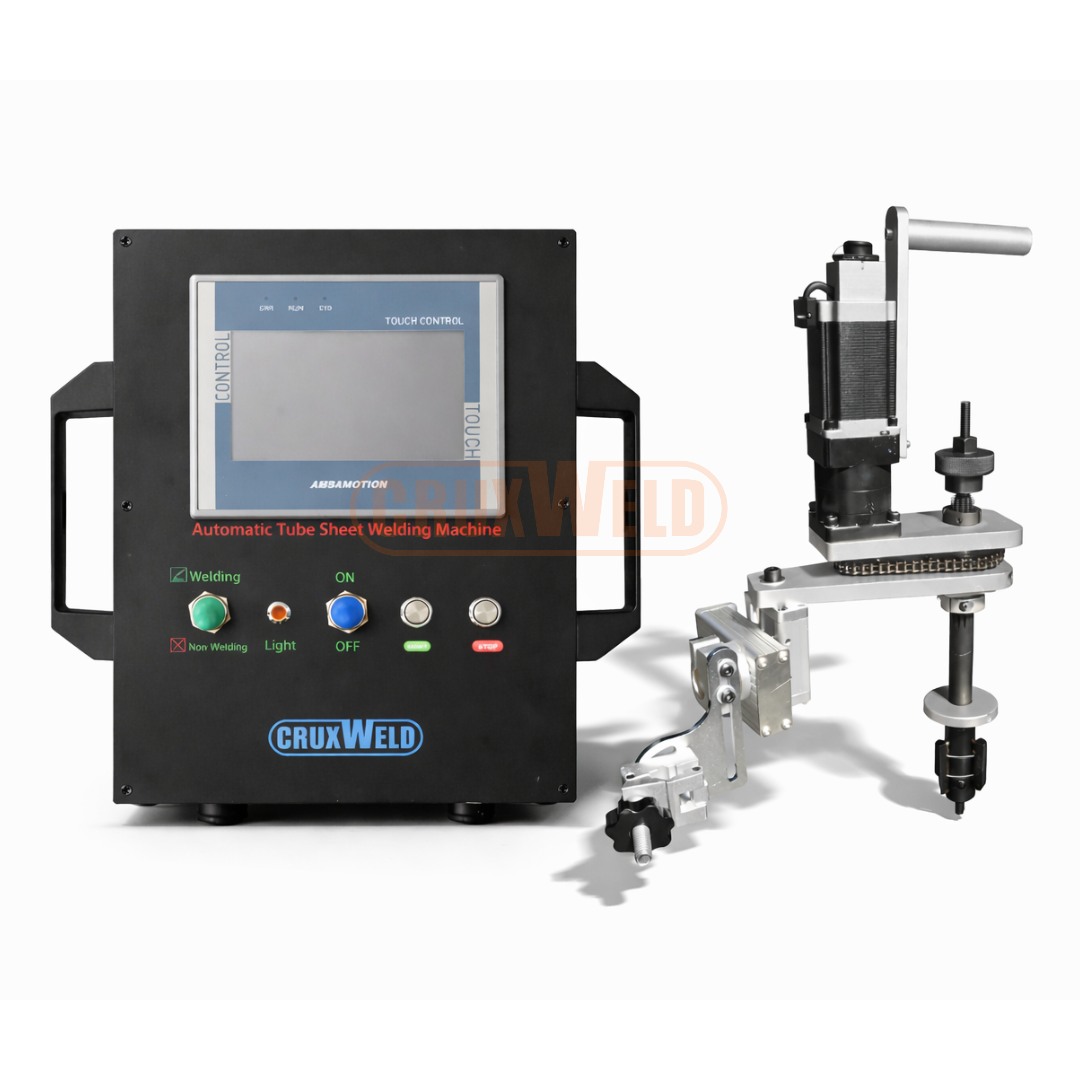
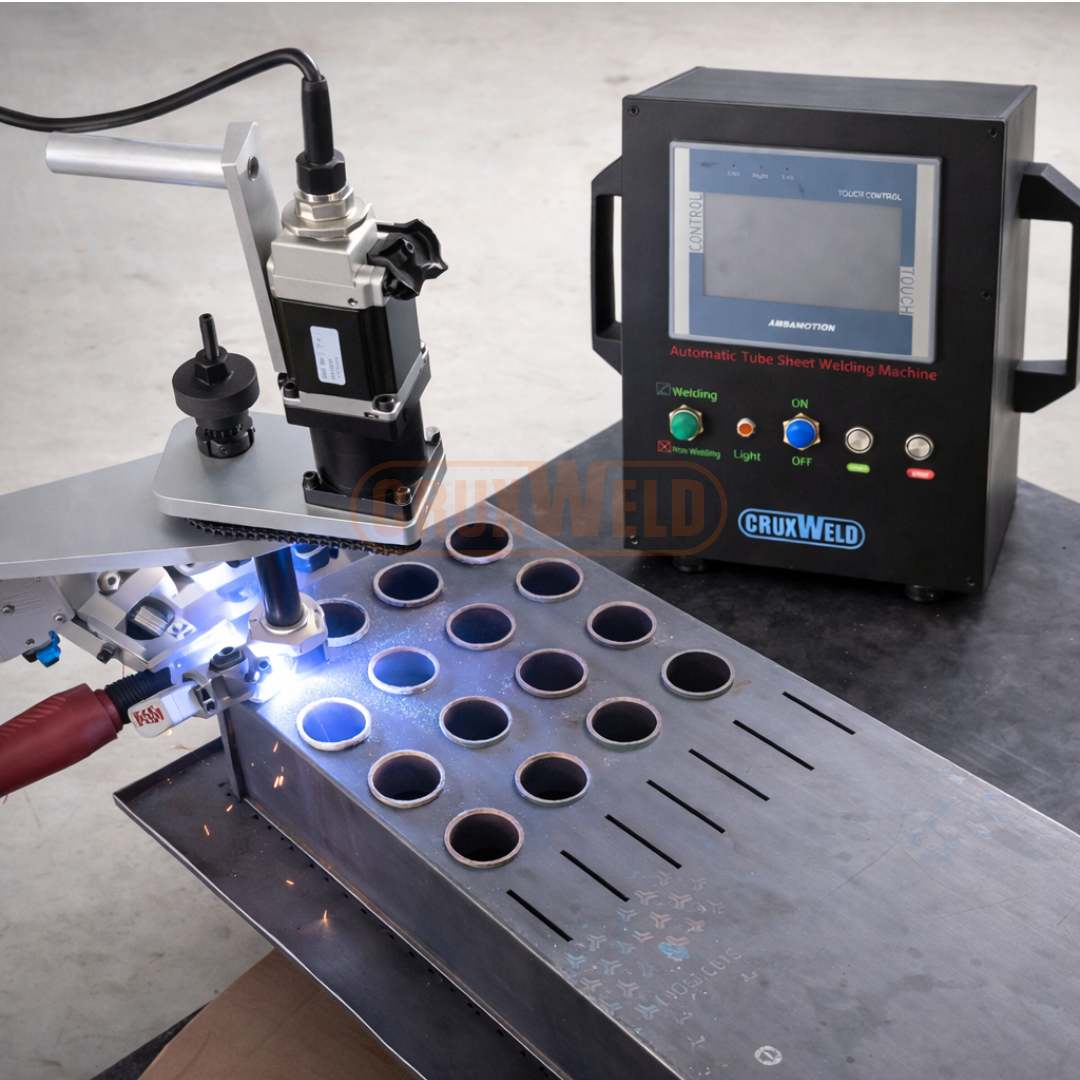
Tube-to-tubesheet welding
Family 4 · Special purpose
TubeSeal H89 clamping head, 28–76 mm tube ID.
A heat exchanger or boiler tubesheet can hold hundreds of identical tube-end welds. The TubeSeal H89 clamps inside each tube and rotates the torch around it, so every joint gets the same path.
Tube ID clamping range 28–76 mm
Torch position X ±60 mm, Y ±60 mm; torch angle ±90°
Programmable rotation with return-to-origin; Start / Pause / Stop
All figures from the Cruxweld product pages. Magnetic carriages need a steel surface; for stainless steel or aluminium, ask us about a track setup.
4 buying mistakes to avoid
Learn from others
Putting a magnetic carriage on stainless or aluminium
Magnetic wheels and rails grip steel only. For non-ferrous jobs, the carriage needs a dedicated track or rail.
Buying twin torches for single seams
A dual-torch carriage pays off only when your parts have two parallel seams. For one seam, a single-torch carriage is the better buy.
Expecting automation to fix poor fit-up
A carriage repeats exactly what you set. Gaps and uneven bevels still show. Mechanised bevelling (DynaMove 45K, WeldOrbit 360) keeps the joint consistent.
Forgetting the power source
The carriage moves the torch; the arc still comes from your MIG welding machine or TIG/SAW source. Match it to your wire, plate and WPS.
What to send us for a fast recommendation
Before you ask for a quote
Material and plate thickness
Joint type and fillet size or leg length
Welding position: flat, horizontal, vertical or overhead
Seam shape and length (straight, or circular with diameter)
Send us your joint, thickness and position. Our technical team will shortlist the right welding automation setup and help you pair it with your power source.
GeM Registered OEM Manufacturer · 45+ years of welding expertise · Supported Worldwide
Frequently asked questions
FAQ
What is a welding carriage?
A welding carriage (also called a welding tractor) is a motorised unit that carries the welding torch along the joint at a set speed and angle. Oscillating models also weave the torch in a programmed pattern, so every pass is repeatable.
Track or trackless — which is better?
Neither is better everywhere. Trackless carriages such as WeldyFi, Dynex 5M and DynaTwin 200M save setup time on steel fillets. Rail systems such as DynaSwing 100K give slip-free travel on vertical and overhead seams. A flexible track (DynaFlex 100S) suits tank and vessel diameters.
Can a magnetic welding carriage work on stainless steel or aluminium?
Magnets need a steel (ferrous) surface. On stainless steel or aluminium, the carriage has to run on a dedicated track or rail. The MIG, TIG and plasma processes themselves work on these metals.
Which carriage is best for vertical and overhead welding?
DynaSwing 100K uses a rack & pinion drive on a permanent-magnet rail, so it does not slip when climbing. For tank shells, DynaFlex 100S handles vertical and overhead seams on its flexible track, and WeldOrbit 360 works in all positions on its magnetic wheel drive.
Can one machine both weld and cut?
Yes. DynaMove 45K, WeldOrbit 360 and DynaFlex 100S accept plasma or oxy-fuel torches for cutting and bevelling. DynaMove 45K also cuts circles from 200 to 2000 mm diameter.
Does a welding carriage replace my welding machine?
No. The carriage mechanises motion and torch position. Welding output still comes from your MIG, TIG or SAW power source and your qualified welding procedure.
What does oscillation (weaving) do?
Oscillation moves the torch side to side during travel. It spreads heat across wider joints, improves side-wall fusion in grooves and gives a uniform cap. Adjustable dwell time at each edge helps prevent undercut.
Welding carriages and oscillators that take the travel speed off the operator and give the same seam every time. Call +91 88008 82983 or message us on WhatsApp.
CRAZY IN LOVE WITH WELDING. Ramakant has a diversified background with industrial experience in welding and production management. He holds a master's degree (M.Tech.) in metallurgy and welding technology from SLIET University. He has experience in a number of industries, including power generation, defense, construction, mining equipment, and heavy engineering fabrication. He holds the positions of welding engineer, quality and inspection officer as well as general management. He has written technical welding articles, contributed to the various welding committees. For the past eight years, Ramakant has been a technical consultant, trainer, and spokesperson for Cruxweld.